
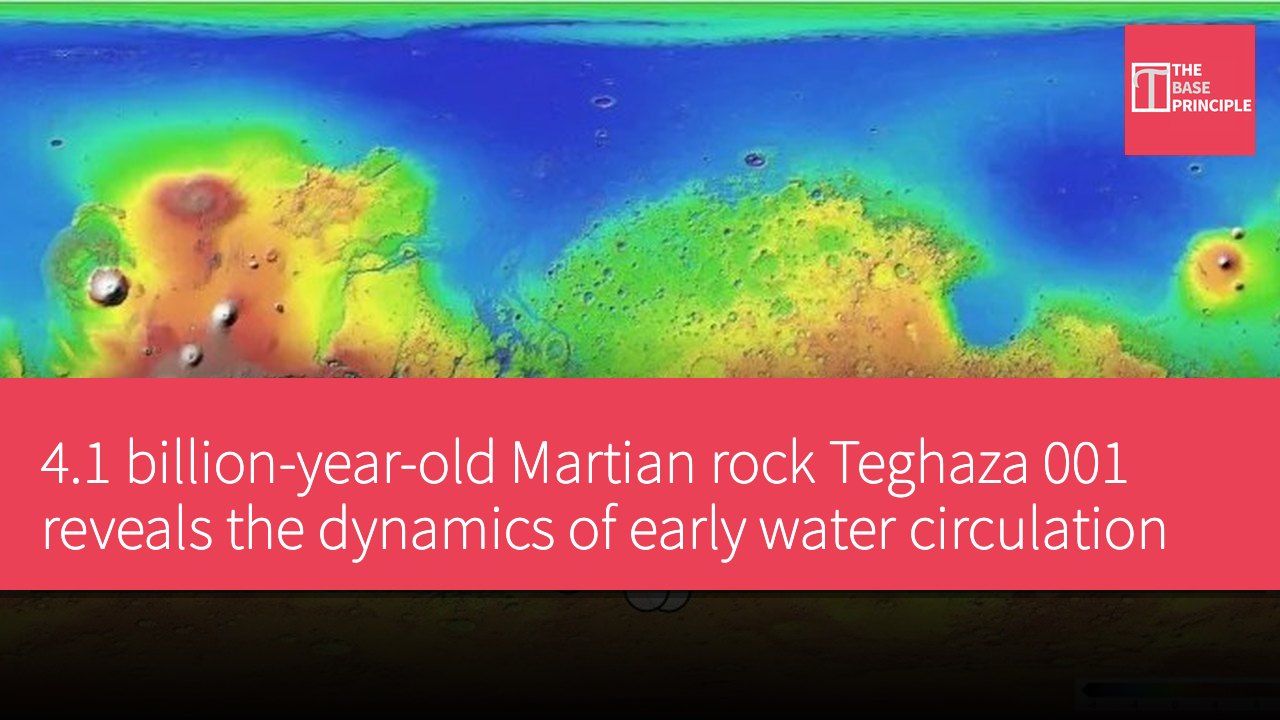
- Teghaza 001 is a piece of Martian crust approximately 4.1 billion years old, revealing the dynamics of early water circulation.
- The uniqueness of this meteorite lies in its complex polymineral volcanic structure.
- Research indicates that early Martian water circulation was more active than previously understood.
- Teghaza 001 provides valuable information regarding the loss of water from Mars' atmosphere.
In 2022, a group of nomadic prospectors stumbled upon a peculiar rose-colored rock in a remote salt flat in Mali, unaware that it was a lost fragment of planetary history. Initially, researchers suspected that the 800-gram sample was merely an ordinary shergottite, the most common type among the approximately 435 Martian rocks that have fallen to Earth. However, recent studies show that the experts' initial assessment was incorrect. Researchers funded by the National Aeronautics and Space Administration (NASA) revealed that the meteorite, dubbed Teghaza 001, is actually a piece of primitive Martian crust dating back about 4.1 billion years.
This discovery makes it one of the oldest known Martian rocks, providing humanity with a rare opportunity to reflect on a time when Mars resembled Earth.
The Uniqueness of Teghaza 001
Mineral and isotopic analyses indicate that around 4.1 billion years ago, groundwater altered this rock, suggesting that early Martian water circulation was more dynamic than previously understood. Scientists have identified 13 locations on Mars that match the mineralogical and chemical characteristics of Teghaza 001, making it one of the oldest Martian meteorites discovered on Earth to date.
This meteorite is remarkable not only for its age but also for the changes it has undergone. Compared to rare counterparts like ALH84001 and "Black Beauty," Teghaza 001 stands out due to its complex polymineral volcanic structure rather than being composed of a single mineral or fragment. Yang Liu from NASA's Jet Propulsion Laboratory stated, "We only realized how unique this meteorite really is after we began to look closely. One reviewer of this paper referred to it as the Rosetta Stone of Mars."
Application of Advanced Techniques
Unlocking the secrets of this rock required seemingly science-fiction-level precision techniques. To date the sample without damaging it, geochemist François Tissot from the California Institute of Technology applied a precise cesium-barium method directly to the rock's surface. Most dating methods require dissolving the entire sample in acid, but this advanced approach preserved the rare Martian specimen. The research team targeted tiny zircon grains in an area smaller than a fingernail, achieving accurate results while maintaining the integrity of the meteorite for future studies. The laboratory results were astonishing, confirming that dynamic active water circulation altered Mars' geology around 4.1 billion years ago.
At that time, Mars began losing its ancient atmosphere. Lee Sapper, the paper's second author, stated, "This is actually the first time we've obtained data from a Martian crustal sample that we never had before. It records the interactions between water and rock and may even preserve traces of the loss of water from Mars' atmosphere."
Impact on Martian Geology
Scientists cross-referenced the mineral characteristics of Teghaza 001 with remote sensing data from NASA's Mars Reconnaissance Orbiter, showing that its chemical features correspond to rocks in the heavily cratered southern highlands of Mars. In those ancient hills, intense cosmic collisions occurred, ejecting this rock into space, which eventually landed in the dunes of the Sahara Desert thousands of years later. Now, this rose-colored alien rock, safely stored in a university vault, is prompting geologists to rethink the cooling of Mars, the formation of continents, and the rate of its drying. Yang Liu noted, "We are just scratching the surface."
The findings of this study have been published in the journal Science.
The Importance of Teghaza 001 for Mars Research
The discovery of Teghaza 001 not only provides scientists with key evidence of early Martian water circulation but also challenges existing understandings of Mars' geological history. The complex structure and chemical characteristics of this meteorite offer clues about changes in Mars' atmosphere, helping researchers understand the cooling process of Mars and the evolution of its surface morphology. As more research unfolds, Teghaza 001 may become an important reference for future Mars exploration missions, driving deeper investigations into Mars and its evolution.