
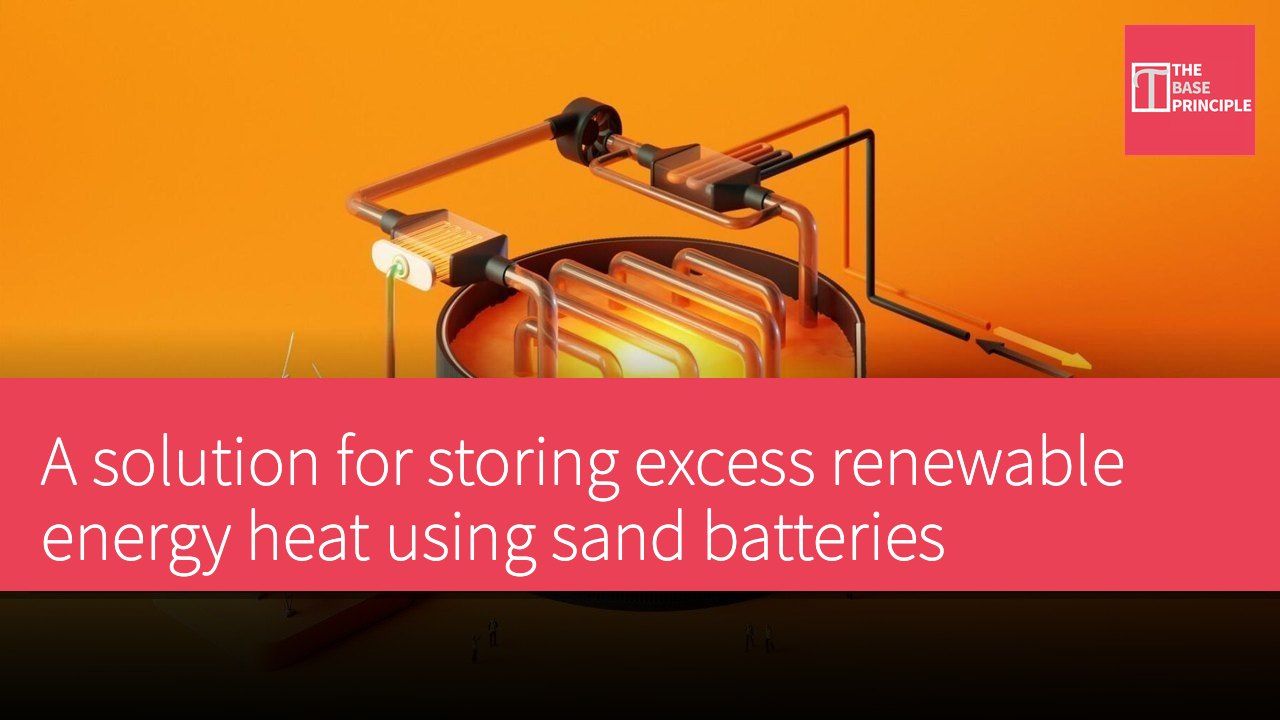
- Sand batteries convert excess electricity into heat, storing it in sand.
- Sand is inexpensive and can stably store heat at high temperatures.
- Sand batteries can address the mismatch between renewable energy supply and demand.
- These systems are not suitable for directly replacing lithium-ion battery storage.
As the power generated by solar panels and wind turbines continues to rise, a challenge has become increasingly hard to ignore. What should be done with renewable energy when it is available but not needed at that moment? To avoid wasting excess electricity, more thermal energy storage systems are exploring a simple solution—heating sand. These systems, known as "sand batteries," convert electricity into heat and store it in large, heavily insulated containers filled with sand or similar solid materials. This heat can be released after a few hours, days, or even months, providing energy for district heating networks and industrial processes.
However, unlike traditional batteries, they are primarily designed to store and deliver heat rather than electricity.
The principle behind sand batteries is relatively simple. When electricity is abundant or cheap, power from the grid or renewable sources (such as wind and solar) is used to drive electric heating elements. These elements heat air or other thermal conduction mediums, which circulate through pipes or channels within the sand-filled container. As the hot air flows through the storage material, it transfers thermal energy to the surrounding sand. Depending on the design, some systems can heat the material to about 600 degrees Celsius (1,112 degrees Fahrenheit). The container is surrounded by thick insulation to slow down heat loss.
Sand is particularly useful because it is inexpensive, widely available, chemically stable at high temperatures, and can store large amounts of thermal energy. Additionally, it avoids the need for lithium, cobalt, and other materials required by some electrochemical batteries.
The amount of energy stored depends on the mass of the material and the degree to which its temperature is raised. Simply put, a larger quantity of sand heated to a higher temperature can store more energy.
When heat is needed, the process runs in reverse. Cold air circulates through the thermal storage material, absorbing its thermal energy, and then passes through a heat exchanger. The recovered heat can be transferred to water for use in district heating networks, used to generate steam to drive industrial equipment, or supplied as hot air for manufacturing and drying processes. The sand remains in the insulated container, allowing the system to recharge when electricity is available. This makes sand batteries particularly attractive for industries that require large amounts of stable heat. Food processing, textiles, chemicals, paper production, and other manufacturing activities often rely on fossil fuels to generate process heat.
A thermal storage system can help meet part of the demand using electricity generated from renewable energy.
Commercial Applications of Sand Batteries
Moreover, it also addresses the issue of mismatched renewable energy production. The output of wind and solar energy can fluctuate throughout the day, while factories and heating networks require a reliable energy supply. Sand batteries can absorb electricity when supply is high and release heat when demand rises.
Polar Night Energy, based in Finland, is one of the most notable examples in this field, having developed a commercial sand battery for the utility Vatajankoski in Kankaanpää, Finland. The facility began operation in 2022, using about 100 tons (approximately 110 US tons) of sand, housed in a steel container about 7 meters (approximately 23 feet) high. It has a storage capacity of 8 megawatt-hours (MWh) and provides heat to the local district heating network.
Subsequently, the company developed a larger facility in Pornainen, Finland. This system uses about 2,000 tons (approximately 2,200 US tons) of crushed soapstone instead of regular sand, which can also store thermal energy. The system has a capacity of 100 MWh and is designed to provide heat to the town's district heating network, reducing reliance on fossil fuels and wood chips.
Challenges of Thermal Storage Systems
These projects demonstrate how solid material thermal storage can extend to municipal and industrial heating. Researchers are also exploring systems that can utilize stored heat to generate electricity. For example, the ENDURING concept from the U.S. National Renewable Energy Laboratory uses electrically heated silica particles stored in insulated silos. When electricity is needed, the hot particles transfer heat to a working gas, driving machinery connected to a generator.
The limitation of sand batteries is that they cannot directly replace lithium-ion battery storage. Their main advantage lies in using relatively inexpensive materials to store large amounts of thermal energy. However, converting the stored heat back into electricity requires additional equipment, such as heat exchangers, turbines, or other power generation systems, which introduces energy losses. Engineering challenges also exist. The thermal conductivity of sand is relatively low, meaning heat does not move particularly quickly through the sand. Systems must be designed to effectively distribute heat, maintain useful output temperatures, and limit losses through insulation. Their economic viability also depends on the ability to access cheap electricity and the local demand for heat.
The best application scenario for sand batteries is not to directly power phones, cars, or homes, but to store renewable energy in a form that can be used by district heating networks and factories. As more wind and solar energy enters the grid, converting occasional excess electricity into reliable heat may become a crucial part of making renewable energy operate around the clock.
Item Specifications Storage Capacity 8 MWh / 100 MWh Materials Used Sand / Crushed Soapstone
Potential and Challenges of Sand Batteries
As a thermal energy storage solution, sand batteries can effectively utilize excess electricity from renewable energy, particularly in the context of fluctuations in wind and solar energy. This system not only reduces reliance on fossil fuels but also provides reliable energy for industrial heating. However, despite the cost advantages of sand batteries, they still face energy losses and engineering challenges in the process of converting heat into electricity. Therefore, future developments need to focus on improving thermal conductivity and system efficiency to better integrate into the renewable energy ecosystem.