
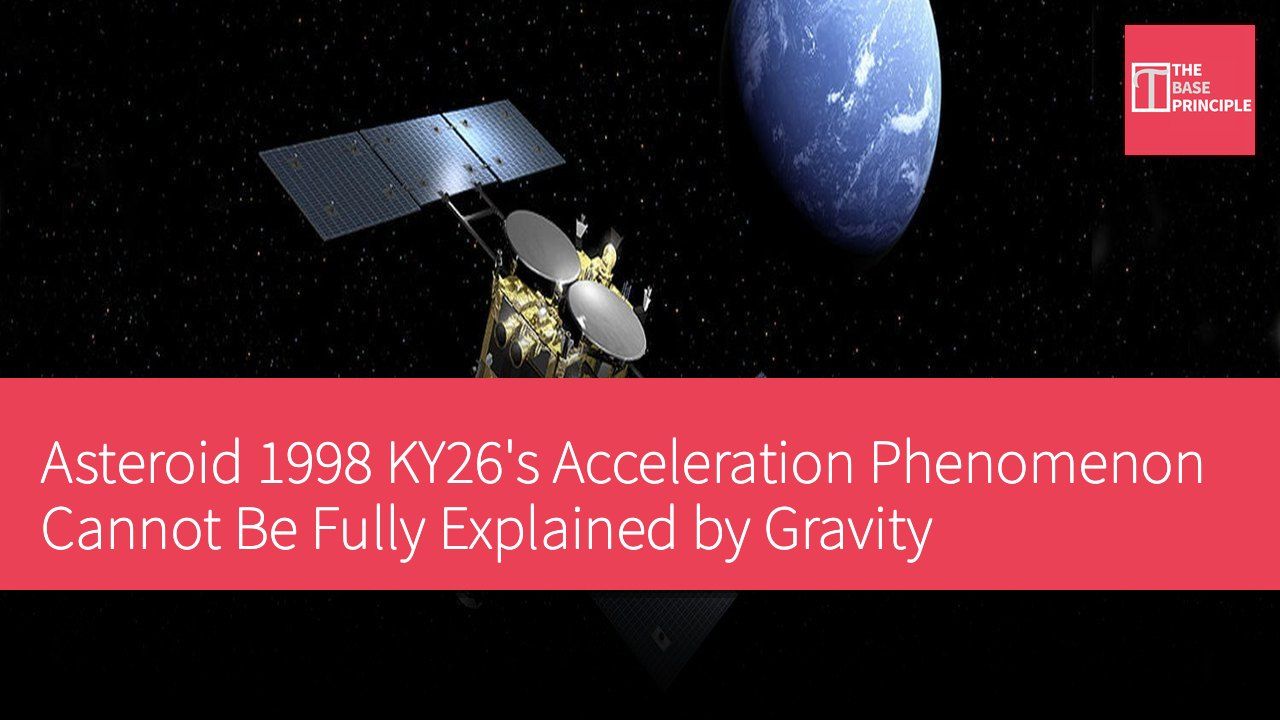
- The acceleration phenomenon of asteroid 1998 KY26 cannot be explained solely by gravity.
- Research shows that KY26's actual size is about one-third smaller than previously thought.
- Scientists considered the Yarkovsky effect but could not explain the observed acceleration.
- The dark comet explanation is unlikely, as the asteroid is not expected to retain sufficient subsurface water ice.
Asteroid 1998 KY26 appears to be accelerating, a phenomenon that cannot be fully explained by gravity. Recent research suggests that the asteroid may be a dark comet ejecting gas from its subsurface ice, although this explanation is considered unlikely. As Hayabusa2 returns with a capsule containing samples from the Ryugu asteroid, the mission successfully landed in Australia on December 6, 2020, and plans to visit 1998 KY26 by 2031. At that time, scientists will be able to observe the asteroid up close.
The asteroid has a diameter of about 11 meters and takes approximately 5.35 minutes to complete one rotation. Research indicates that KY26's actual size is about one-third smaller than previously believed, and its rotation speed is much faster than earlier predictions.
Size and Rotation of the Asteroid
KY26's diameter is only twice that of Hayabusa2's solar panels, making it even more mysterious. Observations indicate that there are non-gravitational components to its acceleration, including a component perpendicular to its orbital plane. For this reason, gravity cannot fully explain its acceleration phenomenon. Scientists are exploring other possible causes, one of which may be the Yarkovsky effect. This effect refers to an object absorbing solar radiation and releasing it as heat, thereby providing a small force that influences the object's orbit over time. However, previous studies found that the observed acceleration exceeds the range that the Yarkovsky effect can explain.
Scientists have also considered the possibility that the asteroid is a dark comet. Such objects may resemble ordinary asteroids but could contain ice beneath their surfaces. As the ice heats up, it turns into gas, providing a small thrust that alters its trajectory. However, according to research by Korbin Hansen and Masatoshi Hirabayashi from Georgia Tech, KY26's temperature is too high to retain subsurface ice. They calculated the internal temperature of the asteroid using current observational data and found that the object's average orbital temperature is at least 212 K (−78.7°F), while water ice needs to be maintained below about 145 K (−198.7°F) to remain stable over geological timescales.
Likelihood of the Dark Comet Explanation
The research indicates that if ice exists underground, water would escape too quickly to provide the necessary gas emissions to explain its acceleration. Therefore, researchers believe the dark comet explanation is unlikely, as the asteroid is not expected to retain sufficient subsurface water ice to sustain the required gas emissions. The study has not fully explained the reasons for the object's motion changes, which may also be influenced by solar radiation pressure and the heat emitted by the object itself. More observations are needed to determine the forces affecting it. Hayabusa2 is set to visit in 2031, which will provide scientists with an opportunity to observe the composition and behavior of the object up close; until then, the asteroid remains a small and mysterious entity.
This visit may help confirm some explanations.
Unsolved Mystery: The Cause of the Asteroid's Acceleration
The acceleration phenomenon of 1998 KY26 has garnered significant attention in the scientific community, as it challenges existing physical theories. Despite various explanations being proposed, including the Yarkovsky effect and dark comet theories, none fully account for the cause of its acceleration. This indicates that there are still many unknowns regarding the motion and physical properties of asteroids. As the Hayabusa2 mission progresses, scientists will have the opportunity to further explore these mysteries, which not only hold important implications for astronomy but may also provide new insights into our understanding of asteroids and their formation processes.