
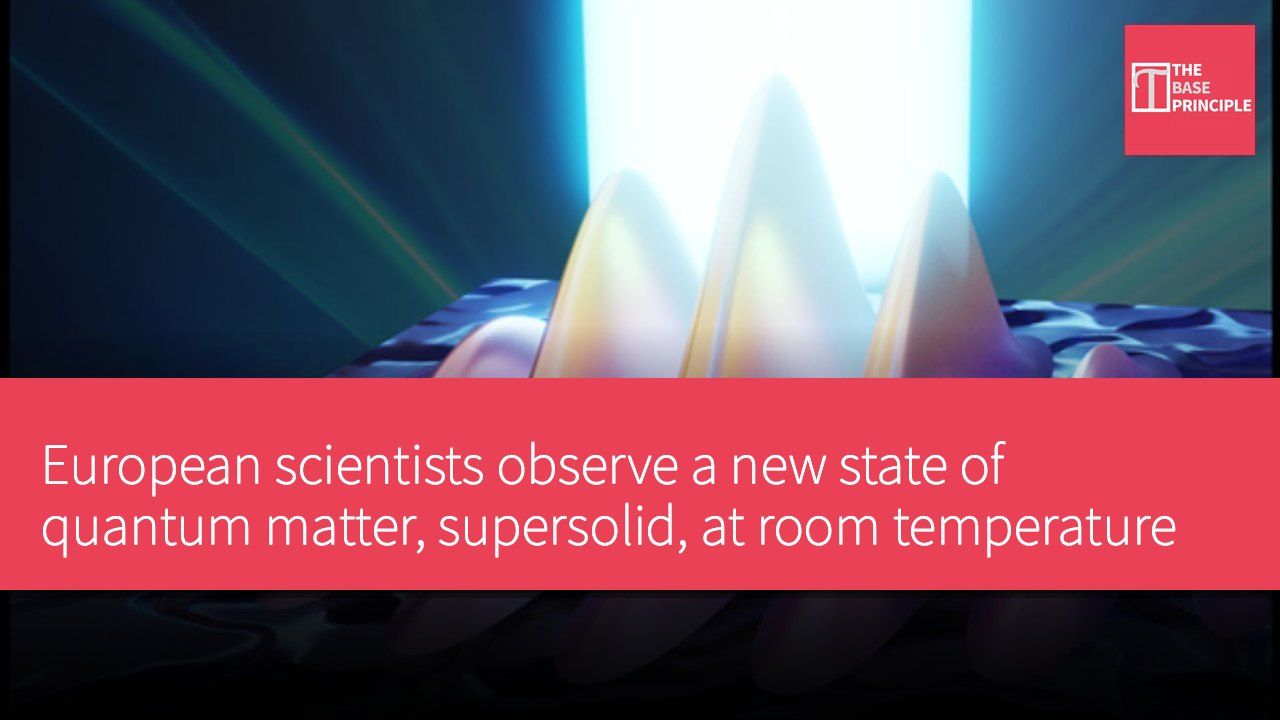
- The research team observed a new quantum state, supersolid, existing in an exciton-polariton Bose-Einstein condensate.
- Exciton-polaritons were generated through optical microcavities, achieving a quantum state at room temperature.
- The identification of the supersolid can be made through bright light stripes emitted from the sample.
- The study shows that quantum states can be observed at room temperature, enhancing the practicality of quantum photonic devices.
A collaborative effort from various research institutions across Europe has observed a new state of matter known as a supersolid, which exists within an exciton-polariton Bose-Einstein condensate. This quantum state can be tuned using electric fields and has been observed at room temperature, paving the way for future quantum photonic devices. As early as the 1960s, physicists theorized that superfluids could develop within crystalline structures. Superfluids are a special state of matter where viscosity completely disappears, allowing fluids to flow without resistance in narrow channels. The existence of such a state within the rigid structure of crystals seems paradoxical, but in 2017, this coexisting phase—supersolid—was experimentally observed in ultracold atomic Bose-Einstein condensates.
Exploration of the New Quantum State
Researchers from the University of Warsaw, the Military University of Technology in Poland, IBM Research Zurich, and the French National Centre for Scientific Research (CNRS) took a different approach to explore whether this quantum state could be realized at room temperature. The researchers utilized strong coupling between light and matter to generate exciton-polaritons—a hybrid quasiparticle—through optical microcavities. The optical microcavity was filled with specially designed liquid crystals and coated with organic semiconductors, enabling coupling even at room temperature. Although these quasiparticles exist for only a few picoseconds, they are sufficient to form a Bose-Einstein condensate, which then exhibits properties similar to quantum superfluids.
This supersolid can be identified by observing the regularly spaced bright light stripes emitted from the sample as it transitions from superfluid to supersolid.
Interestingly, each laser pulse used to excite the sample generates bright light stripes at different locations. "This is a textbook example of spontaneous symmetry breaking," explained Guillaume Malpuech, a professor at CNRS. "Theoretically, supersolids can choose between several equivalent states, and that is exactly what we observed." The research team also noted the simultaneous appearance of two different ordered forms: one is polarization, and the other is light intensity.
Due to the reaction between the organic semiconductors and the liquid crystals, researchers had to ensure that all measurements were completed within a few hours after the sample assembly. Repeating experiments meant starting from new samples, making the research more challenging than anticipated. IBM Research Zurich was responsible for the measurements and deposited organic semiconductor films on the photonic structures fabricated at the Military University of Technology in Poland. Although IBM Research Zurich has collaborated with organic semiconductor films for years and even observed Bose-Einstein condensates on them, this was their first collaboration with liquid crystal microcavities, as noted in a press release.
Quantum States at Room Temperature
Most research on exotic quantum states requires ultracold temperatures close to absolute zero. However, this study shows that these quantum states can also be observed at room temperature through photonic systems.
Wiktor Piecek, a professor at the Military University of Technology, added, "Our liquid crystal microcavity can even operate at temperatures close to 60°C." Because the optical microcavity can be tuned and its properties altered by external voltage, this makes more practical quantum photonic devices possible and can aid in the study of quantum phases of light and matter. The research findings have been published in the journal Science Advances.
Breakthroughs in Supersolid Research and Future Applications
The breakthrough of this research lies in the successful observation of a supersolid at room temperature, which is crucial for the development of quantum technologies. Previously, research focused primarily on ultracold environments near absolute zero, limiting its practicality. Now, through the innovative design of optical microcavities, researchers are able to explore quantum states at higher temperatures, which not only enhances the feasibility of quantum photonic devices but may also promote future applications in fields such as quantum computing and quantum communication.