
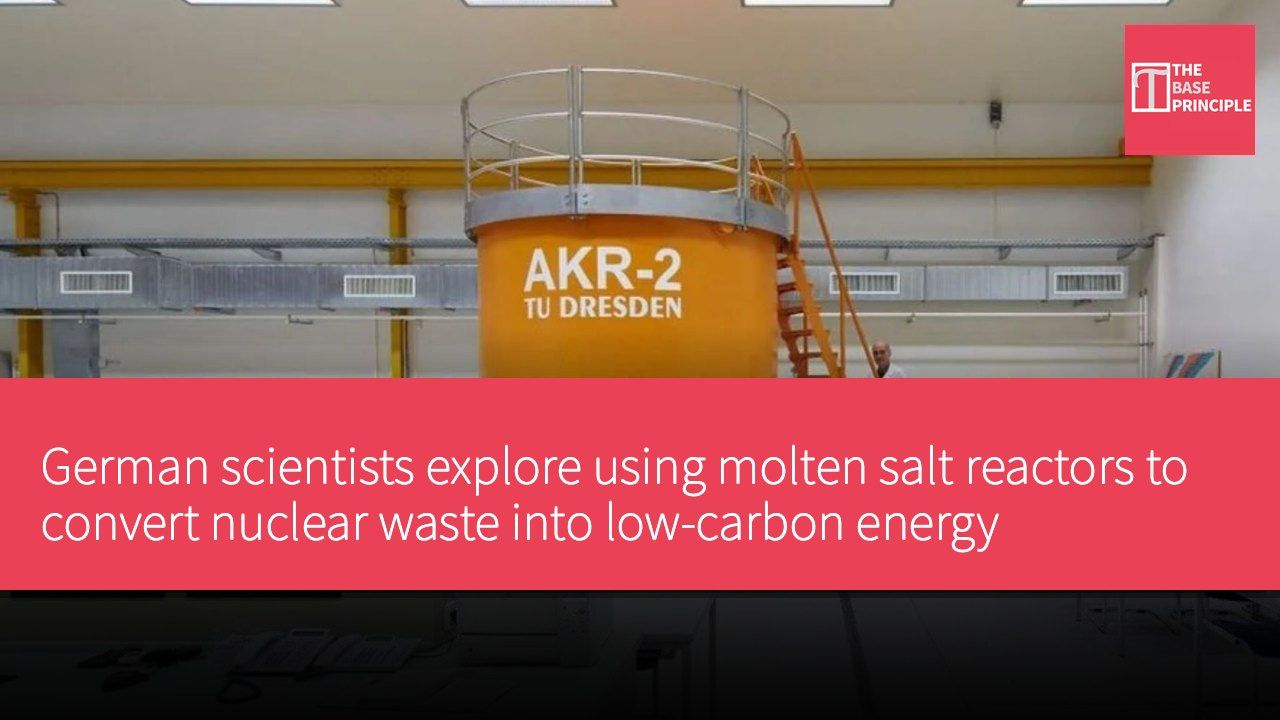
- German scientists are exploring a plan to convert nuclear waste into low-carbon energy.
- The DEMO reactor project could save the country a substantial amount of money.
- This technology avoids the dangers of traditional nuclear recycling and can safely handle high-level radioactive waste.
- The project has the potential to ensure Europe's energy independence and competitiveness.
German scientists are exploring a novel approach to transform used nuclear fuel into low-carbon energy. A feasibility study from Dresden University of Technology outlines a groundbreaking recycling reactor project named DEMO. The research team stated, "High-level radioactive waste is considered one of humanity's most dangerous legacies. To address this issue, Dresden University of Technology plans to build an experimental recycling reactor, DEMO." The project proposes a molten salt reactor capable of consuming used fuel on-site. If successful, Germany's need for deep geological repositories may become obsolete.
According to the proposal, this could save the country €50 billion (approximately HK$48.4 billion).
Innovative method of transformation without reprocessing
The proposal focuses on a method known as "transformation without reprocessing." Traditional nuclear recycling relies on complex chemical processes to extract usable materials, whereas Dresden's design avoids this danger by directly introducing high-level waste (including used fuel and vitrified materials) into a liquid salt carrier. Neutron bombardment will split heavy nuclear waste into lighter elements. Most of the remaining fission products decay to safe levels within decades, rather than thousands of years. Because the remaining waste is primarily short-lived, the research team believes this will circumvent the stringent long-term storage requirements mandated by German federal law.
The energy potential stored in these materials is quite substantial. Researchers have calculated that Germany's stored waste contains enough usable energy to supply the equivalent of 300 times the country's annual electricity demand. In addition to providing clean thermal energy, the reactor will also produce medical radioisotopes crucial for cancer therapies and provide technical data for advanced nuclear fusion research.
Legal design of the DEMO reactor
To eliminate the political obstacles surrounding nuclear power in Germany, the Dresden team designed the DEMO reactor in accordance with the current Atomic Energy Act. Under existing regulations, commercial nuclear power and chemical fuel reprocessing are prohibited. However, DEMO is strictly a non-commercial research facility with a thermal power output of 50 megawatts. Since it does not separate nuclear fuel or produce commercial electricity, planners state it can be legally constructed under existing legislation. "The DEMO project has been strategically designed to allow construction under the current Atomic Energy Act, as it does not involve commercial electricity production or nuclear fuel reprocessing," the research team emphasized.
The project requires approximately €1.95 billion (about HK$18.9 billion) in public investment. Development and construction are expected to take five years, followed by an operational lifespan of 20 years. Authorities have assessed three potential sites in Saxony: the VKTA research park in Rosendorf and two significant industrial transformation centers in Lusatia, namely Schwarze Pumpe and Boxberg. If the experimental phase proves the physics to be sound, researchers hope to revise regulations to allow commercial transformation plants to connect to the grid before 2045. For Saxony, the project presents a strategic opportunity to lead in advanced nuclear recycling, turning an expensive environmental crisis into an exportable global industry.
"The goal is to ensure Europe's energy independence and competitiveness while promoting broad public and political acceptance by addressing or mitigating the issue of final radioactive waste disposal," the team concluded.
Impact of the DEMO project on the future of nuclear energy
The DEMO project aims not only to address the nuclear waste issue but also to potentially reshape the energy landscape in Germany and Europe. The political and legal barriers facing traditional nuclear energy make the emergence of innovative technologies particularly important. By effectively utilizing high-level radioactive waste, the DEMO reactor can provide clean energy and reduce reliance on long-term storage, which is crucial for enhancing public acceptance and policy support. Furthermore, upon successful implementation, Germany will position itself as a leader in the global nuclear recycling sector, further promoting both economic and environmental benefits.