
- The Hong Kong University of Science and Technology has developed a low-cost solid-state cooling structure that can last over 100 million cycles.
- The structure uses sheet-like nickel-titanium alloy, inspired by honeycomb designs to enhance durability.
- The new technology can produce approximately 100 porous alloy chips per minute, with a cost reduction of 95%.
- The research team plans to further improve thermal conduction and drive systems to enhance performance.
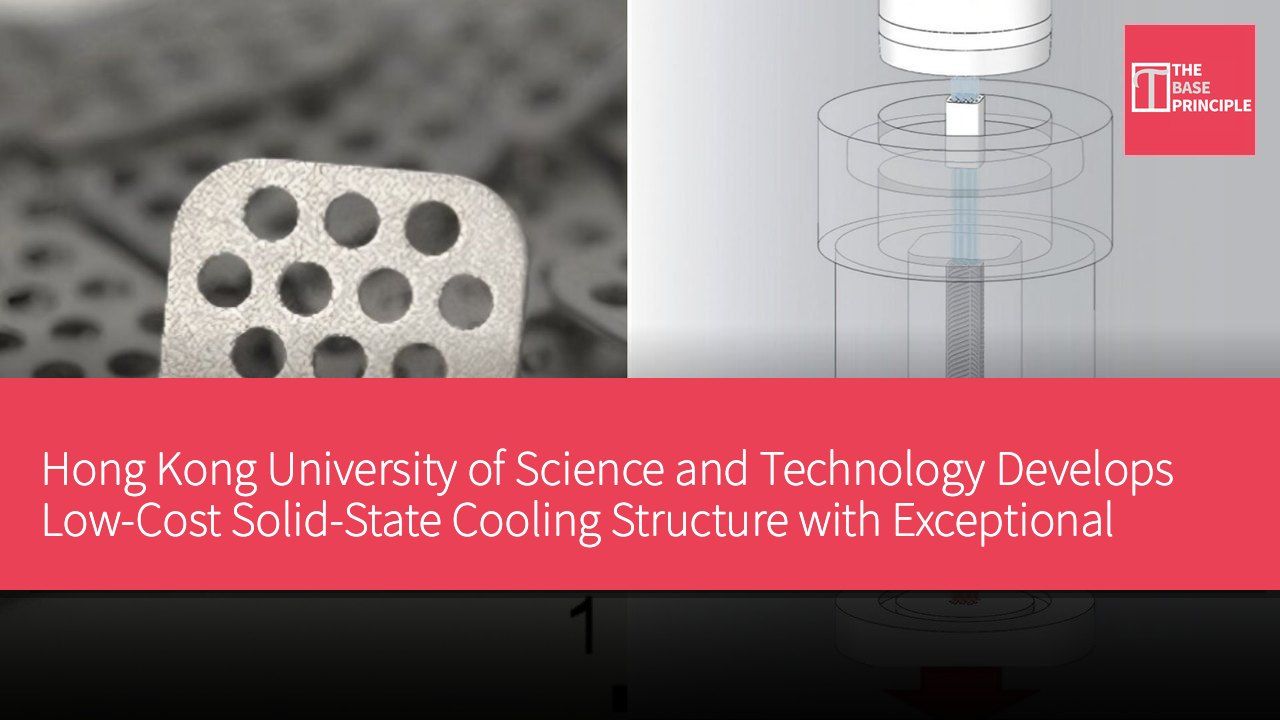
A research team at the Hong Kong University of Science and Technology has developed a low-cost solid-state cooling refrigerant structure that has withstood over 100 million operational cycles in testing. Inspired by honeycomb structures, this design aims to address two major obstacles in thermoelastic cooling technology: production cost and mechanical durability. The structure employs sheet-like nickel-titanium alloy (NiTi), which is stamped into porous chips and stacked to form a tubular refrigerant unit. The research team estimates that under the tested operational conditions, its lifespan could exceed 10 years. The related research findings have been published in the journal Science, titled "Low-Cost, Ultra-High Fatigue Life Stacked Porous NiTi Structures for Thermoelastic Cooling," providing a potential pathway for producing thermoelastic cooling components at a more suitable scale and cost for commercial applications.
Thermoelastic cooling operates differently from traditional air conditioning and refrigeration systems, which typically use vapor compression systems that circulate refrigerants through cycles of compression, condensation, expansion, and evaporation. These systems consume a significant amount of energy, and certain refrigerants may contribute substantially to global warming upon release. Thermoelastic cooling employs a different approach, utilizing shape memory alloys that undergo reversible changes in their internal crystal structure when subjected to mechanical stress. When the alloy is compressed or stretched, this change releases heat, while removing the stress reverses the process, allowing the material to absorb heat. Repeating this cycle, combined with a heat transfer system, can produce a cooling effect without the use of traditional refrigerants.
However, developing practical components remains a challenge, as these components must withstand repeated mechanical loads while providing sufficient surface area for effective heat exchange.
Overcoming Challenges in Traditional Cooling Technology
Existing designs often rely on pipes, plates, and wires, or use wire electrical discharge machining (WEDM) to manufacture thin-walled components. These methods have high production costs and slow speeds, and some structures are prone to fatigue damage. To address these limitations, a research team led by Professor Sun Qingping at the Hong Kong University of Science and Technology developed a technique called "stamping and stacking." The process begins with commercially available nickel-titanium alloy sheets, which are stamped into individual porous chips and then stacked to create a tubular refrigerant structure. Its layered architecture is inspired by the mechanical stability of natural structures, such as honeycombs and bamboo.
Individual chips also help limit the propagation of cracks, preventing cracks from spreading along a continuous pathway that could lead to significant structural failure, while the interfaces between adjacent layers can interrupt their propagation.
Significant Cost and Production Advantages
This manufacturing process offers significant cost advantages. The Hong Kong University of Science and Technology reports that the technology can produce approximately 100 porous alloy chips per minute, over 100 times faster than comparative methods, and at a cost reduction of 95%. Testing has shown that the structure can withstand over 100 million operational cycles. Based on its performance under tested conditions, researchers anticipate its lifespan could exceed 10 years. The team has integrated this structure into a thermoelastic cooling prototype, which features a refrigerant unit measuring just 30 millimeters (about 1.2 inches) long, containing 200 layers of stacked NiTi chips.
The prototype achieved a maximum temperature span of 11.7 Kelvin (about 21°F), with a specific cooling power of 3.85 watts per gram. This temperature span represents the difference the system can establish between the hot and cold sides, rather than a decrease in ambient temperature. The results demonstrate the potential of this design to combine effective cooling performance within a compact size; however, it does not establish the overall energy efficiency or operating costs of a complete commercial cooling system.
Researchers plan to improve thermal conduction, develop more energy-efficient drive systems, and design higher-performance shape memory alloys. The manufacturing method can also be adapted to handle thin alloy sheets processed through laser cutting or etching. The team has applied for multiple international patents for this technology. Although further development is needed before commercial deployment, this work offers a promising pathway to make solid-state cooling components more durable and economical.
Commercial Potential and Challenges of Solid-State Cooling Technology
The solid-state cooling technology from the Hong Kong University of Science and Technology demonstrates potential in reducing production costs and enhancing durability, which is crucial for future cooling systems. Traditional cooling technologies typically rely on energy-intensive vapor compression systems, while this new technology utilizes the properties of shape memory alloys, providing a more environmentally friendly alternative. Although improvements in energy efficiency and operating costs are still needed, this innovation opens new possibilities for the commercial application of cooling technology, particularly in areas requiring efficient cooling.