
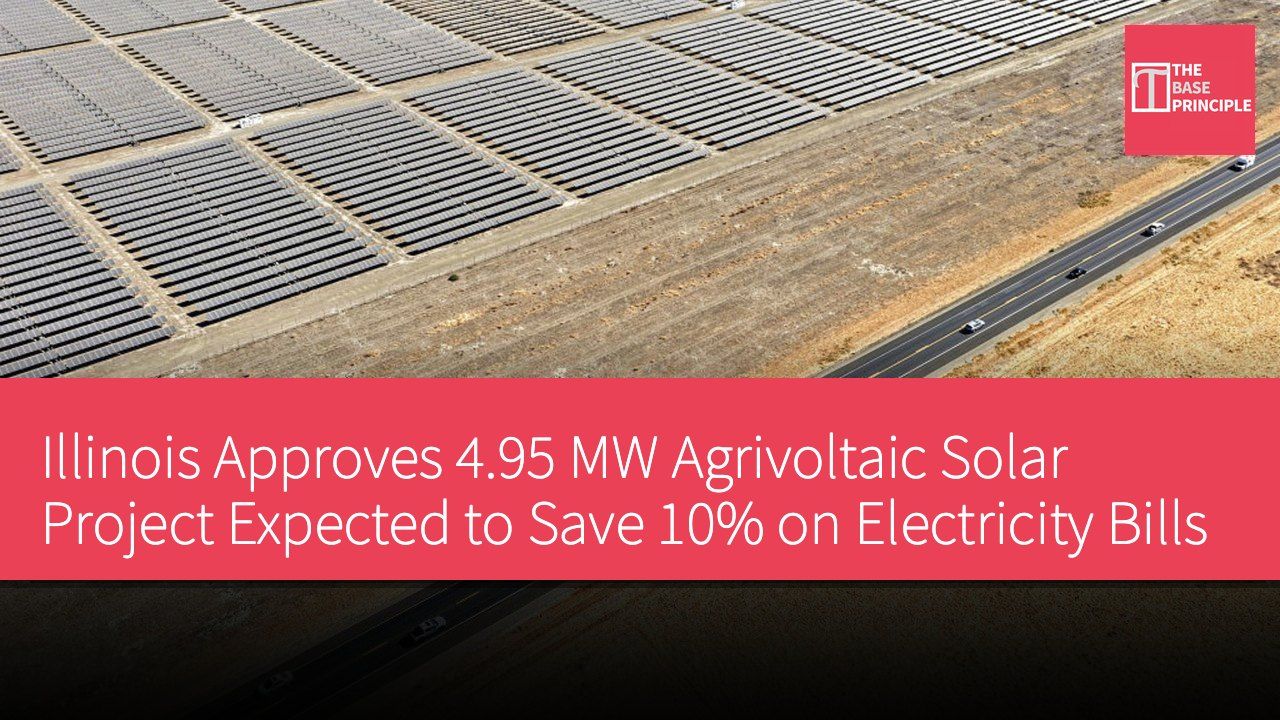
- Illinois has approved a 4.95 MW agrivoltaic solar project.
- The project allows crops to grow between solar panels, maintaining agricultural production.
- Residents and businesses are expected to save about 10% on electricity bills.
- The project will not include battery storage systems, with power flowing directly into the local distribution network.
A 4.95 megawatt (MW) agrivoltaic solar project has been approved in Illinois, paving the way for a community solar facility that will generate renewable electricity while producing hay. According to a news release, the Paxton City Council approved the incorporation agreement for the Baltimore Avenue Solar Project on November 3 (Tuesday), making approximately 35 acres of land part of the city and allowing property tax revenue generated by the development to flow directly to Paxton. Residents, businesses, and public entities participating in the community solar project are expected to save about 10% on their electricity bills.
Advantages of Agrivoltaic Design
Unlike traditional solar farms that often remove farmland from production, this project is designed as an agrivoltaic installation, allowing crops to grow between and beneath the solar panels.
The project is being developed by Boston-based Lightstar Renewables and will occupy about 30 acres of leased agricultural land while maintaining hay production during its operation. The facility will use single-axis solar trackers that rotate throughout the day to follow the sun, which can increase electricity output compared to fixed-tilt panels. The height of the trackers will reach 12 feet (3.7 meters), providing sufficient space for agricultural machinery to continue mowing and baling beneath the panels. The site will also feature livestock-style fencing designed to blend with the surrounding agricultural landscape.
Unlike many modern utility-scale solar facilities, the Baltimore Avenue project will not include battery storage systems. Instead, the electricity generated by the installation will flow directly into the local distribution network through selected existing grid interconnections that have the necessary capacity and proximity. According to the company, the project builds on the experience of DiMartino Farm, New York City's first approved agrivoltaic installation, where hay can still be harvested alongside the solar panels.
Impact of Community Solar Programs
The project will participate in Illinois' community solar program, allowing households, businesses, and public entities to subscribe without installing rooftop solar panels. Subscribers will receive electricity bill credits based on their share of the project's electricity output, with expected savings of about 10% on their bills. The agreement also creates long-term financial benefits for the city government. According to the developer, the project will support the city's revenue for decades while having minimal impact on the demand for municipal infrastructure such as water, sewage, and schools. A separate community benefit agreement will provide additional financial contributions to Paxton.
Last October, Baltimore County, Maryland, launched its first large-scale ground-mounted solar farm, transforming the former Parkton landfill into a hub for clean energy production. The 7 MW installation spans over 213 acres and features four solar arrays with nearly 15,000 ground-mounted photovoltaic panels. Reports indicate that in its first year alone, the site is expected to generate about 8.2 million kilowatt-hours of electricity, enough to meet approximately 11% of the county government's annual electricity needs. Illinois' recent project showcases how agrivoltaics can combine renewable electricity generation with ongoing agricultural production, allowing farmland to provide both crops and clean energy on the same land.
Potential and Challenges of Agrivoltaic Technology
The development of agrivoltaic technology demonstrates the synergistic potential of renewable energy and agricultural production. Such projects not only enhance land use efficiency but also bring economic benefits to communities, such as electricity savings and municipal revenue. However, these projects may face technical, environmental, and policy challenges during implementation. As demand for renewable energy rises, successful agrivoltaic cases may serve as important references for future sustainability.