
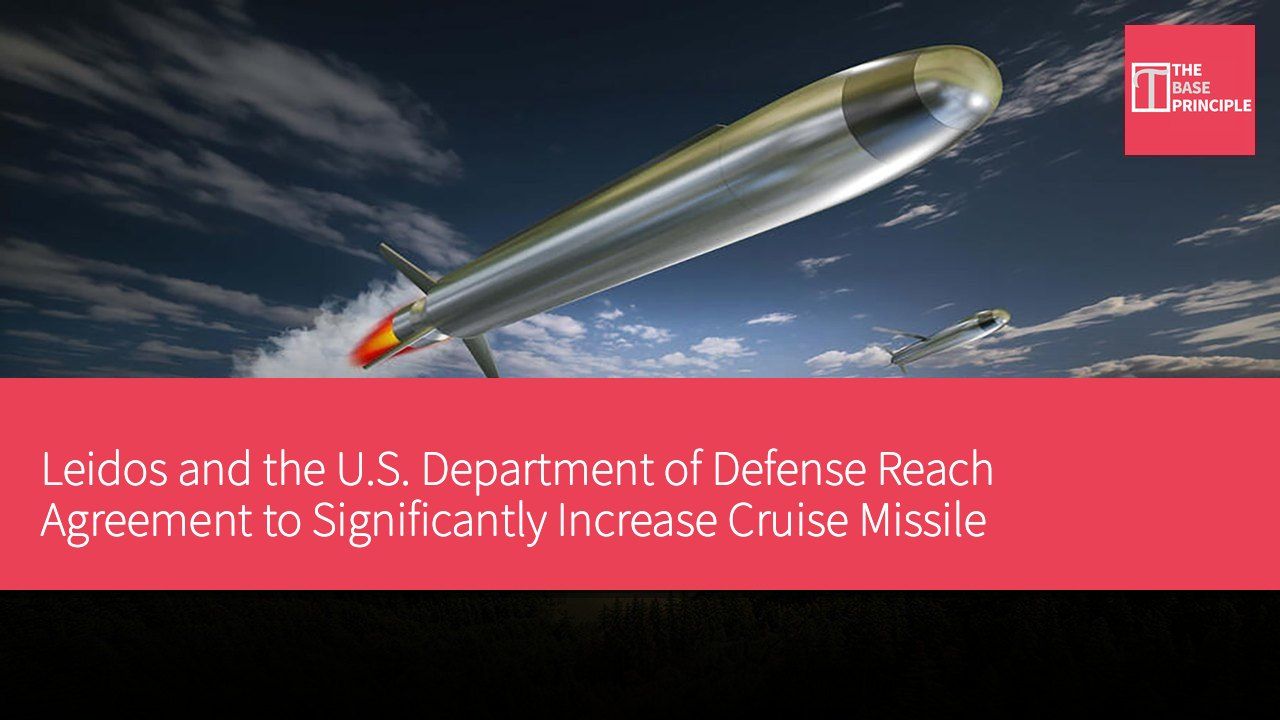
- Leidos has signed a framework agreement with the Department of Defense to produce 3,000 LCCM weapons.
- Initial deliveries of the Havoc Spear have been sent to the Air Force Special Operations Command.
- Leidos plans to conduct weapon production in Alabama and Tennessee.
- The Pentagon is expanding its cruise missile production lines to meet demand.
Leidos is collaborating with suppliers across 14 states in the U.S. to build thousands of cruise missiles, the defense contractor announced in a statement on November 2. The company held a supplier summit at its headquarters in Reston, Virginia. Leidos stated that the meeting coordinated consensus among partners on the demand, manufacturing capabilities, timelines, and delivery plans for two types of weapons: the Low-Cost Containerized Missile (LCCM) and the AGM-190A Havoc Spear.
Autonomous Flight Capability of Cruise Missiles
Cruise missiles are guided weapons capable of flying autonomously to their targets. According to Leidos, this work supports the framework agreement signed with the Department of Defense on May 13, which includes an initial contract for 3,000 LCCM weapons, and supports what Leidos describes as the combat-validated Havoc Spear.
Cindy Gruensfelder, president of Leidos Defense, stated that the company is investing in its workforce, facilities, and supply chain to deliver with a "real sense of urgency." Leidos indicated that production of both weapons will primarily take place in Huntsville, Alabama, and McEwen, Tennessee. According to Defense Post, the company is also preparing to increase the production of the Havoc Spear. Leidos reported that initial deliveries of the Havoc Spear have begun to be sent to the Air Force Special Operations Command.
Leidos has also secured a contract from U.S. Special Operations Command for 45 missiles, with deliveries expected to begin in the fall of 2027. Jessica Villardi, vice president of combat and mobility programs at Pratt & Whitney, stated that the company is investing in capacity and advanced manufacturing. Ben Nicholson, chief business officer of Divergent, remarked, "I have never seen a prime contractor gather suppliers like this."
A prime contractor is the main contractor for a specific program. Leidos stated that the company has decades of experience in designing and integrating missile systems, launchers, and precision strike technologies, including the Army's Indirect Fire Protection Capability Increment 2 launcher and hypersonic strike technologies. Hypersonic weapons fly at speeds exceeding five times the speed of sound.
Pentagon Expands Production Lines
Leidos's plans come as the Pentagon is expanding several cruise missile production lines. According to Defense Post, RTX's Raytheon received a seven-year, $22.9 billion contract in August to accelerate Tomahawk production, with an annual output expected to exceed 1,000 missiles. The Air Force announced in July that it anticipates purchasing up to 16,450 missiles over the next five to seven years across two programs: the Joint Air-to-Ground Standoff Missile and the Long-Range Anti-Ship Missile, both produced by Lockheed Martin.
In the same month, the Pentagon announced framework agreements with Anduril, CoAspire, and Zone 5 Technologies for low-cost air-launched cruise missiles.
Several details remain unconfirmed, with most information coming from Leidos, which did not disclose contract values or the number of suppliers in its statement. Framework agreements typically establish terms ahead of final orders. The first LCCM missiles are intended for testing, so the weapon's performance in service has not yet been validated. Leidos is not the only LCCM contractor; according to Air & Space Forces Magazine, Anduril, CoAspire, and Zone 5 have also been selected.
Leidos expects the first LCCM missiles to enter testing and evaluation in 2027, with full-scale production planned for 2028 and 2029.
Leidos's Production Plans and Defense Needs
Leidos's cruise missile production plans reflect the growing demand from the U.S. Department of Defense for advanced weapon systems. As geopolitical tensions escalate, the need for high-performance weapons is becoming increasingly urgent. Leidos's investments not only enhance its own production capabilities but also facilitate supply chain integration, which is crucial for meeting future military needs. Furthermore, the Pentagon's initiatives to expand production lines demonstrate an emphasis on diversifying weapon systems, which will help enhance the operational capabilities of the U.S. military.