
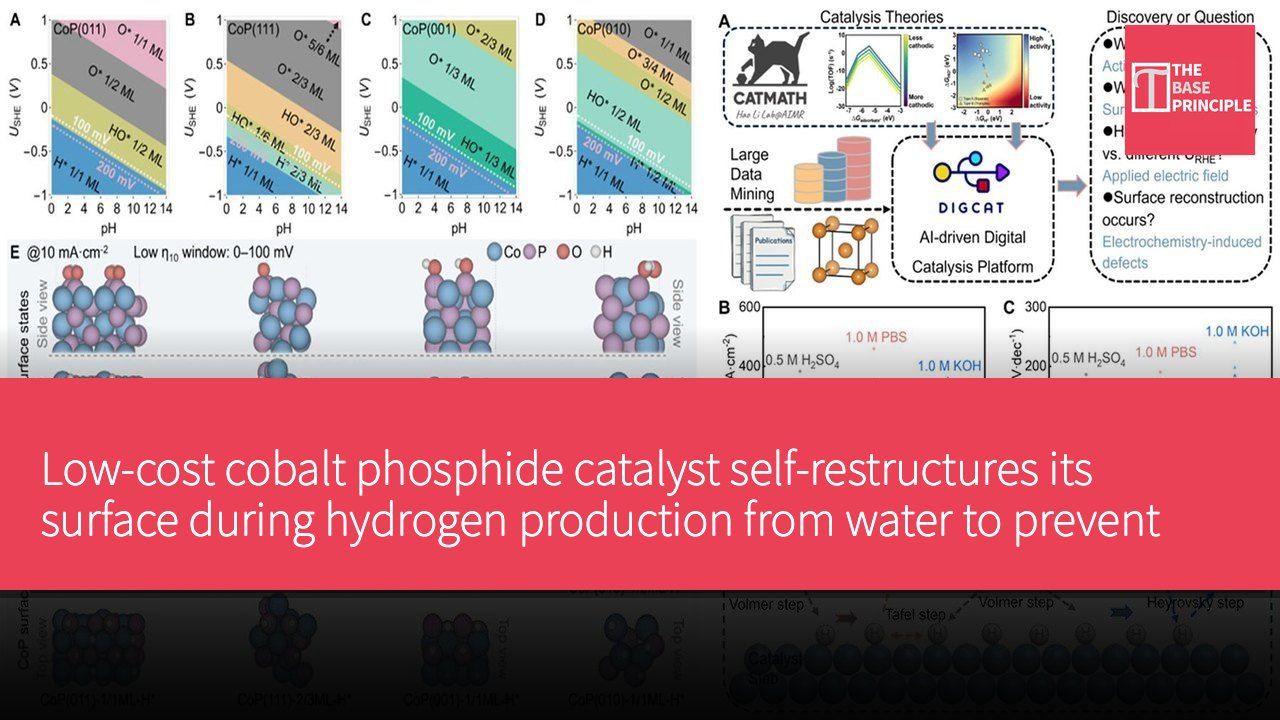
- The cobalt phosphide catalyst can self-restructure its surface during hydrogen production from water to prevent damage.
- CoP is seen as a low-cost alternative for hydrogen production, with greater potential compared to platinum.
- The catalyst maintains activity across different pH levels and forms a protective layer to limit oxidation.
- The reconstruction strategy proposed by the researchers could promote cheaper green hydrogen production.
Researchers at Northeastern University have stated that a low-cost catalyst known as cobalt phosphide (CoP) self-restructures its surface during the process of producing hydrogen from water, a change that seems to protect it from damage. The study was published on October 29 in the Journal of the American Chemical Society, with Professor Hao Li from the university's Advanced Materials Research Institute serving as the senior author. Among the 12 authors, Zhongyuan Guo is listed first. A catalyst is a material that accelerates a chemical reaction without being consumed. Water splitting uses electricity to break water into hydrogen and oxygen, with the hydrogen generation portion requiring a catalyst.
The university describes CoP as a promising and lower-cost alternative for hydrogen production from water compared to platinum. Computer models predict that CoP would be unstable under hydrogen production conditions, but laboratory experiments have shown that it remains active and durable in acidic, neutral, and alkaline water.
Characteristics and Advantages of CoP Catalyst
The study proposes that the surface of CoP changes during the electrolysis process with the applied voltage. At lower voltages, hydroxyl groups (P-OH, linked oxygen and hydrogen atoms) form at phosphorus sites, helping nearby cobalt atoms activate water and bond with hydrogen; at higher voltages, the surfaces of cobalt and phosphorus become filled with hydrogen-containing species (Co-H and P-H). The research team notes that this helps balance the strength of hydrogen bonding and release across a wide range of pH levels. The paper refers to this phenomenon as surface dynamics in operation, meaning that the catalyst's surface changes while it is working, rather than beforehand.
These surface species also appear to form a protective layer. According to the published data, this protective layer limits oxidation and prevents cobalt and phosphorus from dissolving, which explains why CoP can survive under conditions where models predict it would decompose.
Future Research Directions and Challenges
Researchers at Northeastern University described an independent surface reconstruction strategy for low-cost hydrogen cathodes in 2025. The research team analyzed approximately 886 CoP-based catalysts with 2,282 observations from about 700 publications, utilizing AI-assisted data mining, computer simulations, and laboratory experiments. They subsequently conducted predictive tests on CoP nanosheets, which are ultra-thin sheets of the material. Spectroscopy confirmed the predicted surface species, and experiments with deuterium supported the bonding of hydrogen with phosphorus.
The catalyst performed strongly across all three pH levels and required relatively low additional voltage, although the published data did not provide specific numbers. It remained stable at a current density exceeding 1 ampere per square centimeter (approximately 6.5 amperes per square inch) for 24 hours.
The current results are still preliminary. The published data describes this mechanism as a proposal, reporting only 24 hours of testing without providing voltage data, cost data, or funding sources, nor does it specify CoP's performance over longer operational periods. Another non-precious metal cobalt oxide catalyst operated for over 100 hours at high current. The authors suggest that these findings could help develop cheaper and more versatile catalysts for producing green hydrogen, which is generated using renewable electricity, while designers should consider surface changes under actual operating conditions.
Potential Impact of Cobalt Phosphide Catalyst
The research on cobalt phosphide catalysts demonstrates their potential in hydrogen production, particularly in reducing costs. Their ability to maintain stability in different pH environments makes them more feasible for practical applications. The self-restructuring surface phenomenon mentioned in the study effectively prevents damage to the catalyst, which is crucial for long-term operation. Future research will need to further validate their performance over extended periods and explore how to translate these findings into practical commercial applications, especially in the field of green hydrogen production.