
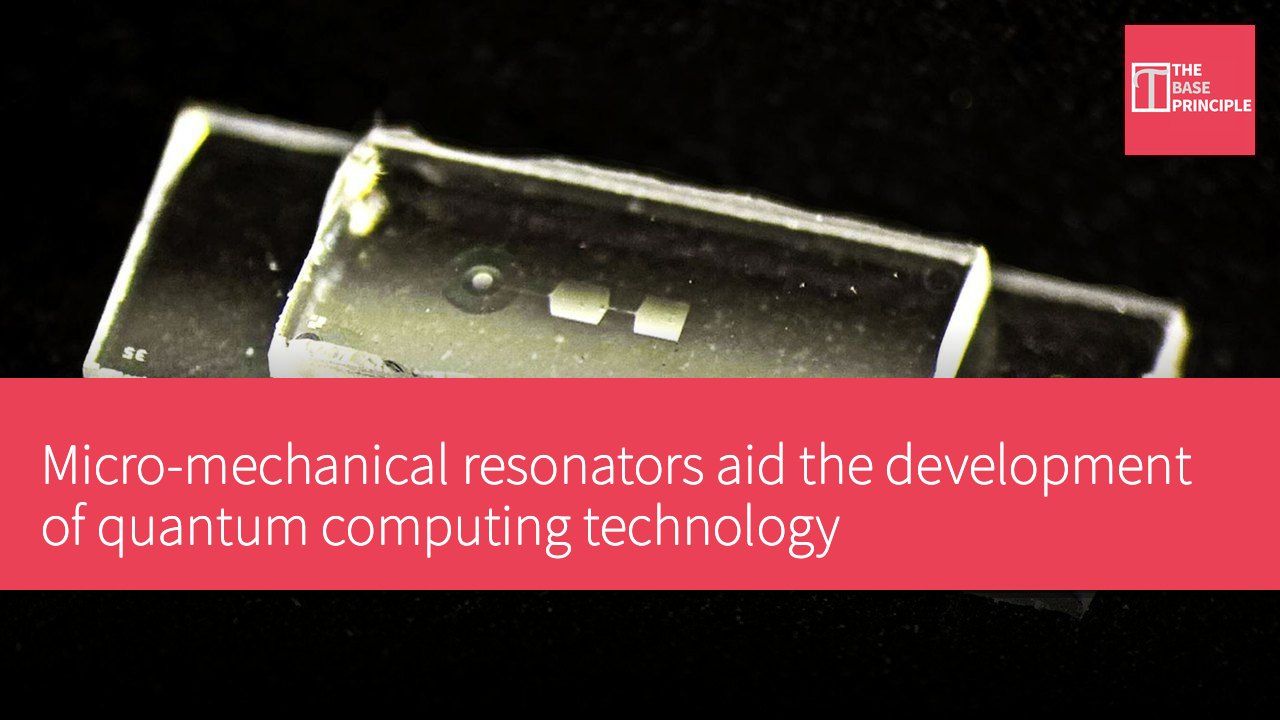
- Researchers developed micro-mechanical resonators to store and manipulate quantum information.
- The system uses superconducting qubits as processing units, similar to traditional computer principles.
- Mechanical resonators can address the issue of limited space in quantum computers.
- Experiments demonstrate that the system can perform various quantum computing operations, showcasing its potential.
Researchers at ETH Zurich have developed a system that utilizes microscopic mechanical vibrations and superconducting circuits to store and manipulate quantum information. This research, led by Yiwen Chu, has created a system that uses superconducting qubits interfacing with mechanical resonators that exhibit multiple vibrational modes. These modes, known as phonons, operate at inaudible high frequencies. The mechanical resonators possess unique vibrational patterns, akin to how guitar strings produce different notes based on their vibration modes.
This design employs principles similar to those of traditional computers. The central processing unit performs complex calculations, while random access memory stores information. Chu's quantum system follows a similar principle. Superconducting qubits act as processing and control units, analogous to a central processing unit (CPU). Meanwhile, an independent quantum memory temporarily holds the information needed during computations, allowing the processor to retrieve and modify this information as required.
Advantages of Mechanical Resonators
Many quantum computers use electromagnetic modes to store information, which can lead to space limitations and reduce the size of the equipment. The use of mechanical resonators can address this issue, as there are many highly coherent modes available in a compact package. Additionally, the quantum states used for information storage are prone to loss. The resonators used in the prototype are a type of high-overdriven bulk acoustic wave device. All components are mounted on a chip measuring 0.3 inches (7.5 mm) long, 0.1 inches (2.5 mm) wide, and 0.04 inches (1 mm) high.
The numerous phonon modes allow for various methods of information storage, while superconducting qubits provide control capabilities.
Researchers found that their system can not only perform information storage operations but also execute other operations. Experiments demonstrated a complete set of quantum gates, including single-qubit gates and controlled arbitrary phase gates. Important operations such as quantum Fourier transforms and quantum period-finding algorithms have also been completed. The Fourier transform is a fundamental operation used in many quantum algorithms, while period-finding illustrates how quantum computers can identify repeating patterns in mathematical problems. "The Fourier transform is essential for many quantum algorithms, and period-finding shows how it can be applied," said Igor Kladarić, a doctoral student in Chu's research group and a co-author of the study.
Future Potential of Quantum Computing
The results indicate that mechanical resonators can be used alongside superconducting qubits to perform quantum computing operations, demonstrating the potential for creating quantum random access memory and effectively storing information. However, the system is still in the experimental stage. Currently, there is a limitation on the number of modes interacting with the qubits. Researchers are working to improve the coherence of the system and explore different designs. Enhancing the readout speed of the qubits will be crucial for scaling this design, as reliability is needed for it to function effectively. This research shows that mechanical vibrations could become a promising component of quantum hardware.
Future quantum machines may incorporate not only electronic and electromagnetic components.
Item Specifications Size 0.3 inches (7.5 mm) long, 0.1 inches (2.5 mm) wide, 0.04 inches (1 mm) high
Prospects of Mechanical Vibrations in Quantum Computing
As quantum computing technology advances, effectively storing and processing quantum information has become a key challenge. Research shows that micro-mechanical resonators can provide multiple storage methods and, when combined with superconducting qubits, demonstrate the potential for creating quantum random access memory. This not only helps address space limitations but also enhances the reliability and efficiency of quantum computing. As research progresses, future quantum computers may integrate more mechanical components, driving further breakthroughs in technology.