
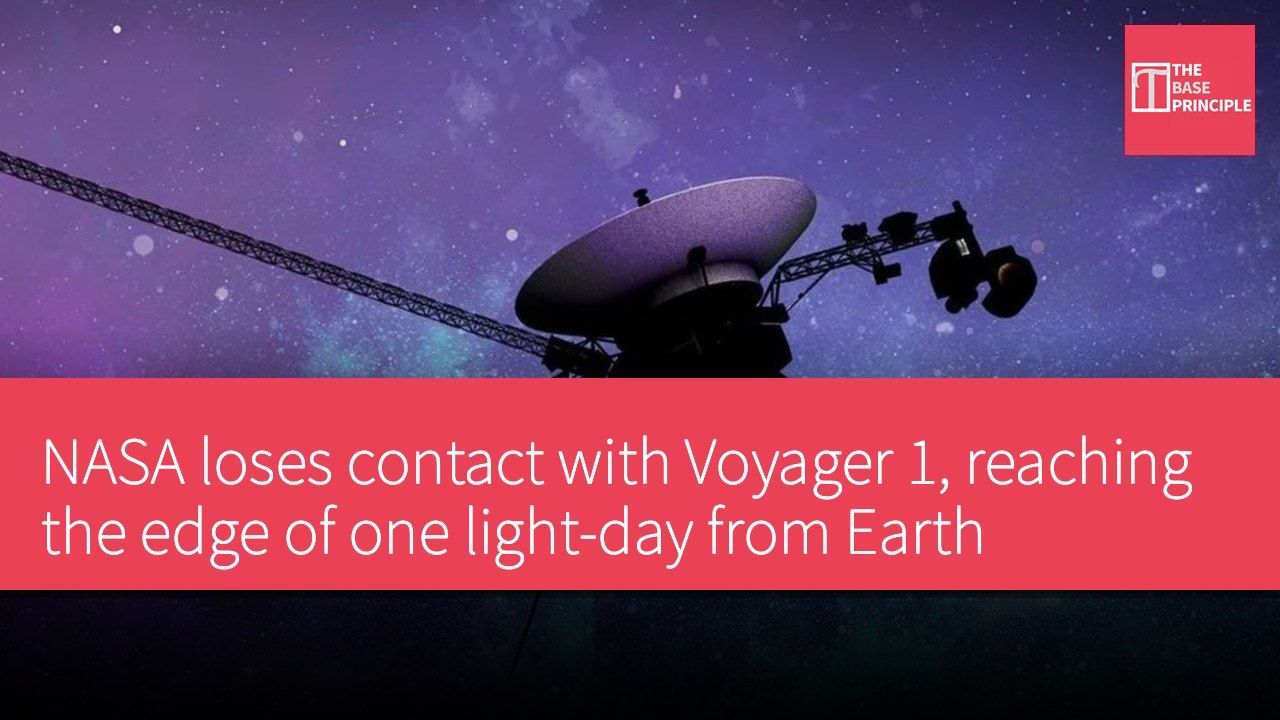
- NASA temporarily lost contact with Voyager 1, with the signal restored two days later.
- Voyager 1's primary thrusters failed, triggering backup systems to maintain stability.
- The spacecraft's onboard power supply continues to diminish, with NASA working to extend its lifespan.
- Voyager 1 will become the first human-made object to reach a distance of one light-day from Earth.
NASA temporarily lost contact with Voyager 1 in mid-October as the nearly 50-year-old spacecraft stopped sending detectable radio signals during two scheduled communication attempts. The signal was restored on October 20, approximately 48 hours after the interruption began. NASA stated that since then, the team has maintained contact with the spacecraft. This incident occurred just before Voyager 1 was expected to become the first human-made object to reach a distance of one light-day from Earth, at which point radio messages would take a full 24 hours to travel. NASA's Deep Space Network is a global system of large radio antennas used to communicate with distant spacecraft, but it failed to detect Voyager 1's signal on October 18 and 19.
The spacecraft is currently about 16 billion miles (approximately 24 billion kilometers) from Earth. Communication was restored on October 20, within about 48 hours of the interruption. NASA indicated that the team has been in contact with the spacecraft since then.
Thruster Failure and Automatic Protection Systems
Engineers are still working to determine the trigger for the communication interruption. However, NASA has confirmed that during the event, a set of thrusters on Voyager 1 lost effectiveness, prompting its backup thrusters to automatically activate. The spacecraft is designed to respond in this way when its onboard computer detects potential issues with the primary thrusters. This automatic protection system allows the spacecraft to enter a stable and safe configuration and suspend normal operations, enabling engineers to conduct investigations. The spacecraft's signal had already been restored before the team sent troubleshooting commands from Earth.
"This is the first time we have seen the spacecraft do this, but we are also at a stage in the mission where we need to anticipate unexpected situations," said NASA's Voyager program manager Kareem Badaruddin. "We are glad to have reestablished contact with Voyager 1 and are eager to understand what happened."
Challenges in Extending Voyager 1's Lifespan
This incident serves as a reminder of the challenges faced in operating a spacecraft launched nearly half a century ago, particularly as its onboard power supply continues to diminish. NASA is working to extend Voyager 1's lifespan. Voyager 1 and its twin Voyager 2 rely on radioisotope thermoelectric generators (RTGs), which convert the heat from decaying plutonium into electrical power. As the radioactive material decays, the spacecraft loses about four watts of power each year. To keep the spacecraft operational, engineers are gradually shutting down instruments and other systems that are no longer critical to its mission.
In September, the Voyager team completed a significant energy-saving operation on Voyager 1, referred to as the "Big Bang." Engineers simultaneously turned off three instruments and activated low-power alternatives to help reduce energy consumption while maintaining the spacecraft's thermal balance. This procedure aims to extend the operational life of Voyager 1's remaining scientific instruments. Without these changes, NASA estimates that another instrument would need to be shut down before the summer of 2027.
Both spacecraft are currently traversing interstellar space, beyond the vast bubble created by particles and magnetic fields generated by the Sun (known as the heliosphere). They remain the only spacecraft to directly study this region. Voyager 1 is approaching another significant milestone. NASA expects that on November 18, 2026, the spacecraft will reach a distance of 16.094 billion miles (approximately 25.902 billion kilometers), equivalent to one light-day. A light-day is the distance light travels in 24 hours. Since radio signals travel at the speed of light, it will take a full day for messages to reach Voyager 1.
It will take another day for the spacecraft's response to return. This means that even if everything operates normally, simple communication with the spacecraft will require about 48 hours.
Currently, Voyager 1 is traveling at a speed of about 38,000 miles per hour (approximately 61,155 kilometers per hour). The spacecraft was launched in September 1977 and has become the farthest human-made object from Earth, far exceeding the planets it was originally sent to explore. While the one light-day milestone will not change the spacecraft's environment or operations, it will provide a significant benchmark showing how far humanity's most distant explorer has traveled and how long its signals take to reach Earth.
Item Specification Distance from Earth 16 billion miles (approximately 24 billion kilometers) Speed 38,000 mph (approximately 61,155 kph) Launch Date September 1977
Significant Milestones and Challenges for Voyager 1
The upcoming milestone of Voyager 1 reaching one light-day marks the limits of human exploration and highlights the challenges of operating a spacecraft in extreme environments. With onboard power diminishing year by year, NASA faces pressure to maintain this historic spacecraft's operation. The recent communication interruption event demonstrates the effectiveness of the spacecraft's automatic protection systems, but it also reminds us that ongoing technical support and innovation are crucial for the success of long-term space missions.