
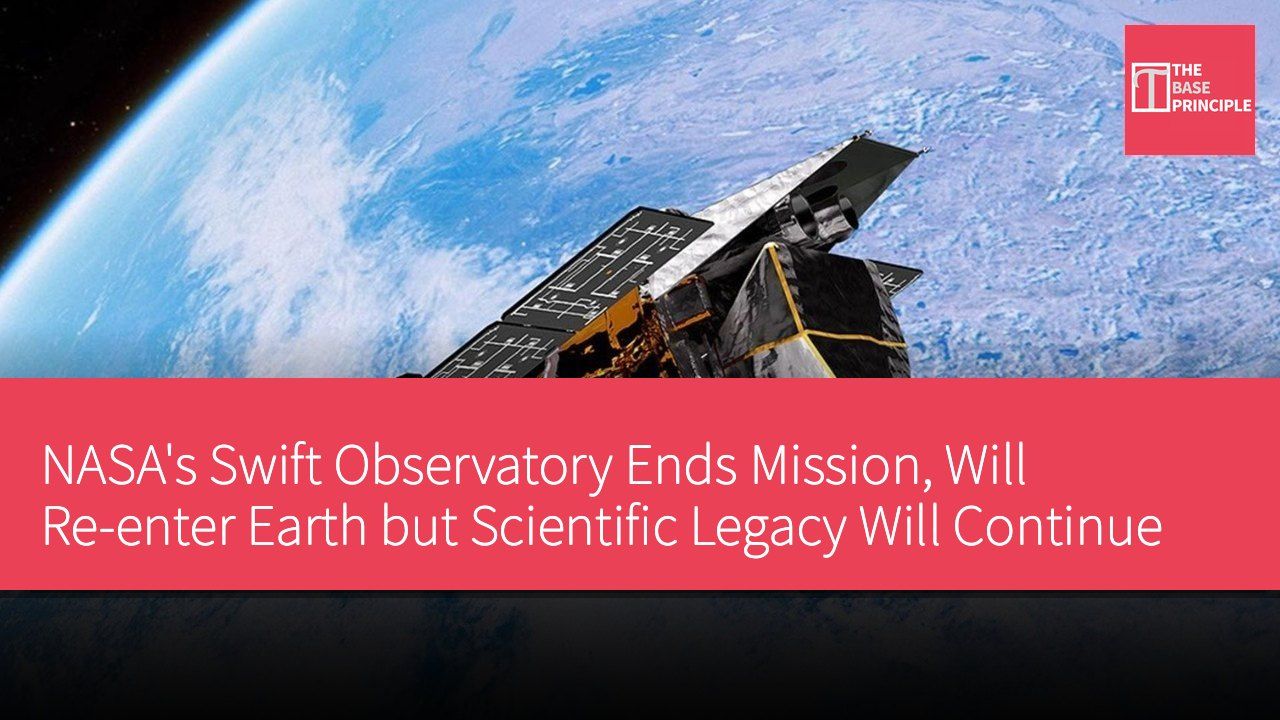
- The NASA Swift Observatory has ended its mission and will return to Earth, but its scientific legacy continues to develop.
- During its operation, Swift observed over 2,000 gamma-ray bursts.
- The spacecraft's observational data will continue to provide value to researchers.
- NASA is exploring new methods to maintain rapid-response observations of cosmic events.
After more than 21 years of observing some of the universe's most violent events, NASA's Neil Gehrels Swift Observatory has concluded its mission. The spacecraft is expected to re-enter Earth's atmosphere in the coming weeks, but its scientific legacy is far from over. Researchers will continue to mine its vast database of observations for years to come, potentially uncovering new findings even after the telescope itself has disappeared. NASA announced on October 23 that Swift has ended its scientific operations due to its orbit descending to a point where it can no longer reliably target astronomical objects.
Its final observation occurred on October 20, while it was operating in an orbit approximately 171 miles (about 275 kilometers) above Earth. The observatory was originally designed for a two-year mission but operated for more than a decade beyond its planned lifespan, observing phenomena ranging from distant stellar explosions to black holes and objects within our own solar system.
Swift was launched on November 20, 2004, primarily designed to detect gamma-ray bursts (GRBs), which are brief but extremely energetic flashes associated with some of the most powerful events in the universe. These bursts can last from fractions of a second to several minutes. Due to their fleeting nature, they are quite challenging to study. Astronomers must quickly locate them and direct other telescopes to the source, or the light will fade away. Swift was built for this purpose, with its burst alert telescope capable of detecting gamma-ray bursts and determining their locations, allowing the spacecraft to rapidly point its X-ray and ultraviolet/optical telescopes at the events.
NASA stated that the observatory could typically reorient its instruments in about one minute. This rapid response capability has transformed the study of gamma-ray bursts, making Swift an essential tool in time-domain astronomy, a field that studies how astronomical objects change over time.
Achievements of Swift's Observations
During its operation, the spacecraft observed over 2,000 gamma-ray bursts and studied more than 1,400 supernova explosions. It also monitored active galaxies powered by supermassive black holes, observed stars being torn apart by black holes, and studied comets and asteroids. One notable observation occurred in 2022 when Swift helped investigate GRB 221009A, nicknamed BOAT (Brightest of All Time). This extraordinary radiation outburst became one of the brightest gamma-ray events ever recorded.
Swift's descent rate has accelerated due to increased solar activity. As the sun becomes more active, it heats the upper atmosphere of Earth, causing it to expand. This increases drag on low Earth orbit satellites, gradually slowing their speed and lowering their altitude. NASA attempted to extend Swift's lifespan through an unusual servicing mission. The agency collaborated with Katalyst Space Technologies in Arizona to develop a robotic spacecraft named LINK, designed to rendezvous with, capture, and boost Swift's orbit.
LINK was launched on July 3, 2026, aboard Northrop Grumman's Pegasus XL rocket. However, due to attitude control issues, the spacecraft was unable to capture or boost Swift's orbit. NASA announced in August that it would no longer attempt to boost the orbit, although LINK would continue to demonstrate rendezvous and close-proximity operations. As Swift continued to lose altitude, its scientific operations ultimately became unsustainable. NASA concluded the mission on October 20, after the spacecraft entered safe mode.
Ongoing Value of the Database
Although Swift is set to disappear from orbit, its observational data will still be available to researchers. NASA stated that the mission has generated approximately 12 TB of data, including nearly 22 years of brightness measurements, multi-wavelength spectra, and over 1.5 million images from its ultraviolet/optical telescope. This database has already contributed to around 7,000 scientific papers. As astronomers revisit old observational data, combining it with new measurements and applying improved analytical techniques, its value may continue to grow.
NASA's Swift database makes the mission's observational results publicly accessible, allowing researchers worldwide to explore its data. However, Swift's departure will leave a gap. NASA is exploring ways to maintain rapid-response observations of cosmic events using existing space telescopes and potential new commercial capabilities. For a spacecraft that has spent over two decades chasing some of the most fleeting and energetic flashes in the universe, its final chapter is particularly unusual. Swift may soon burn up in Earth's atmosphere, but the cosmic events it captured will continue to provide data for astronomers long after its final signal has faded.
Long-term Impact of Swift's Observational Data
Although the Swift mission has concluded, the observational data it collected will continue to have a profound impact on the field of astronomy. This data not only covers gamma-ray bursts and supernova explosions but also includes other astronomical phenomena, providing a rich resource for future research. As analytical techniques advance, researchers will be able to revisit this data and potentially uncover new scientific findings. NASA is also exploring new observational methods to fill the gap left by Swift's departure, demonstrating a commitment to ongoing observations of cosmic events.