
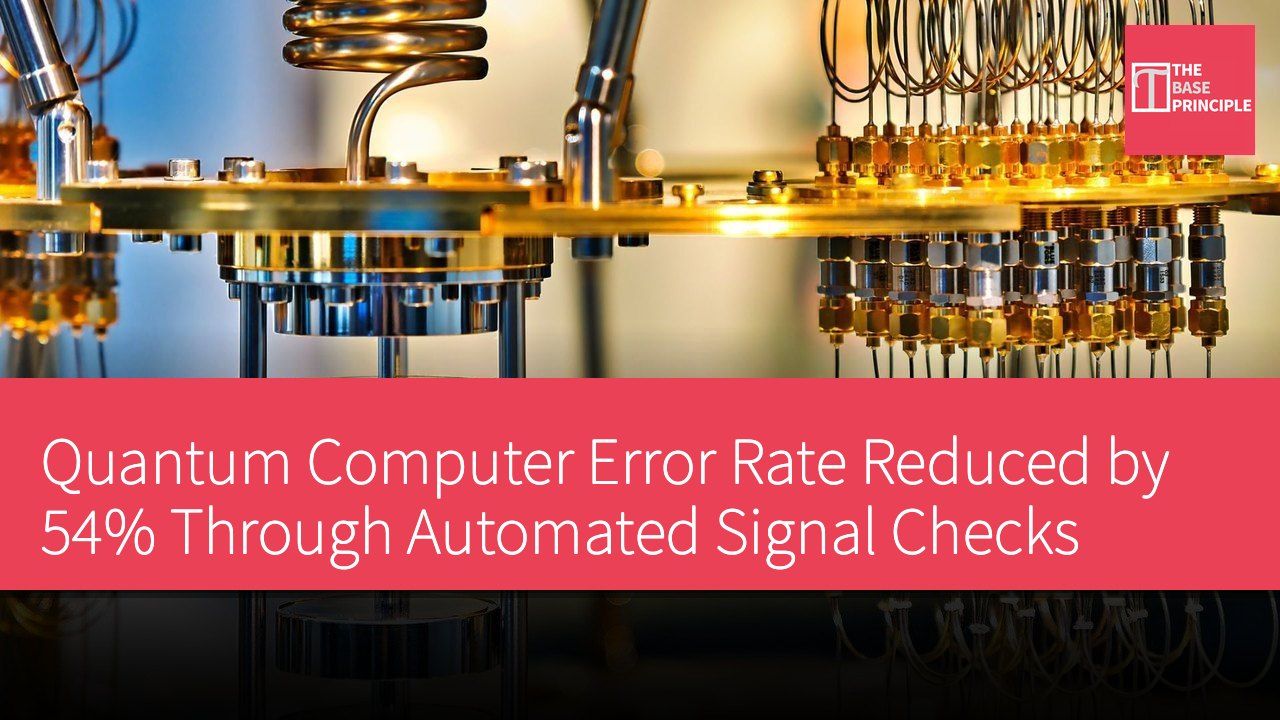
- The research team reduced the quantum computing error rate by 54% through diagnostic checks.
- Performance fluctuations in qubits primarily stem from microscopic defects within the chip.
- The new method introduces real-time feedback, enhancing qubit stability.
- Commercial quantum computers require a large number of qubits to work in concert to maintain fidelity.
Physicists have discovered a simple method to prevent quantum computers from losing coherence. By adding a diagnostic check before running calculations, an international research team has reduced processing errors by 54%. This technique, published in the Applied Physics Reviews, addresses one of the biggest bottlenecks in modern quantum engineering: the extreme physical fragility of qubits. Unlike traditional computer chips, which operate as standard binary switches to process data, quantum processors rely on physical circuits controlled by quantum physics. In a new study, the team tested a superconducting circuit on a chip and guided the system using ultra-precise microwave pulses.
The experiments were conducted at the Israel Quantum Computing Center, with researcher Fabrizio Berritta remotely operating the hardware from the Massachusetts Institute of Technology.
In unadjusted tests, the team observed significant performance fluctuations in qubit operations over time. The culprit behind this was microscopic defects within the chip. Material defects caused the circuit's resonance frequency to fluctuate between two different states. This frequency determines the precise microwave signals required to program the processor. Researchers stated in a press release, "You can think of this as an instrument. If the instrument is slightly out of tune, the same action will no longer accurately produce the expected note." If the frequency changes unexpectedly, incoming pulses will miss their target.
Although the circuit can still operate, the calculations will fail. Previous experiments could identify such changes, but they could not be corrected during active computations.
Real-Time Feedback Mechanism of the New Method
The new method introduces real-time feedback. Before each calculation run, the system briefly prepares the qubits and tracks their behavior. Since each frequency state has significant markers, the system can immediately identify the channel in which the qubit resides. The control computer then re-targets the microwave pulses to match that frequency before running the logic gates. This automatic adjustment provides immediate stability. In benchmark tests, the average error rate of the qubits decreased from 0.14% to 0.065%. During peak interference, the error rate dropped by as much as 77%. Currently, the method still requires prior knowledge of two frequency options, and the qubits must remain in that state long enough for the adjusted microwave signals to take effect.
However, lead researcher Ferdinand Kuemmeth, an experimental physicist at the University of Regensburg and the Niels Bohr Institute in Copenhagen, noted that this technique addresses an urgent industrial challenge. "In the long run, as quantum materials become cleaner, it will be necessary to operate millions of nearly perfect qubits simultaneously," Professor Kuemmeth explained. He pointed out that even the purest chips of the future will still contain scattered defects, and his laboratory has designed automated tools to detect unknown frequency jumps.
Challenges for Future Quantum Computing
Commercial quantum computers will require a large number of qubits to work together without losing fidelity. Researchers believe that by embedding self-correcting feedback directly into hardware control lines, future quantum processors could ultimately operate reliably on a large scale. Kuemmeth stated, "I firmly believe that as we enter the upcoming era of quantum computing expansion, our method will become extremely valuable and have a significant impact on the practical computational capabilities of quantum computers."
Stability and Future Development of Quantum Computing
The development of quantum computing faces challenges due to the fragility of qubits, particularly performance fluctuations caused by microscopic defects. This new technology improves qubit stability through real-time feedback, highlighting the importance of automation and immediate adjustments in the field of quantum computing. As quantum materials advance, future quantum computers will need to operate a large number of qubits simultaneously, which is crucial for achieving commercial applications. The researchers' efforts not only address current technological bottlenecks but also lay the groundwork for the long-term development of quantum computing.