
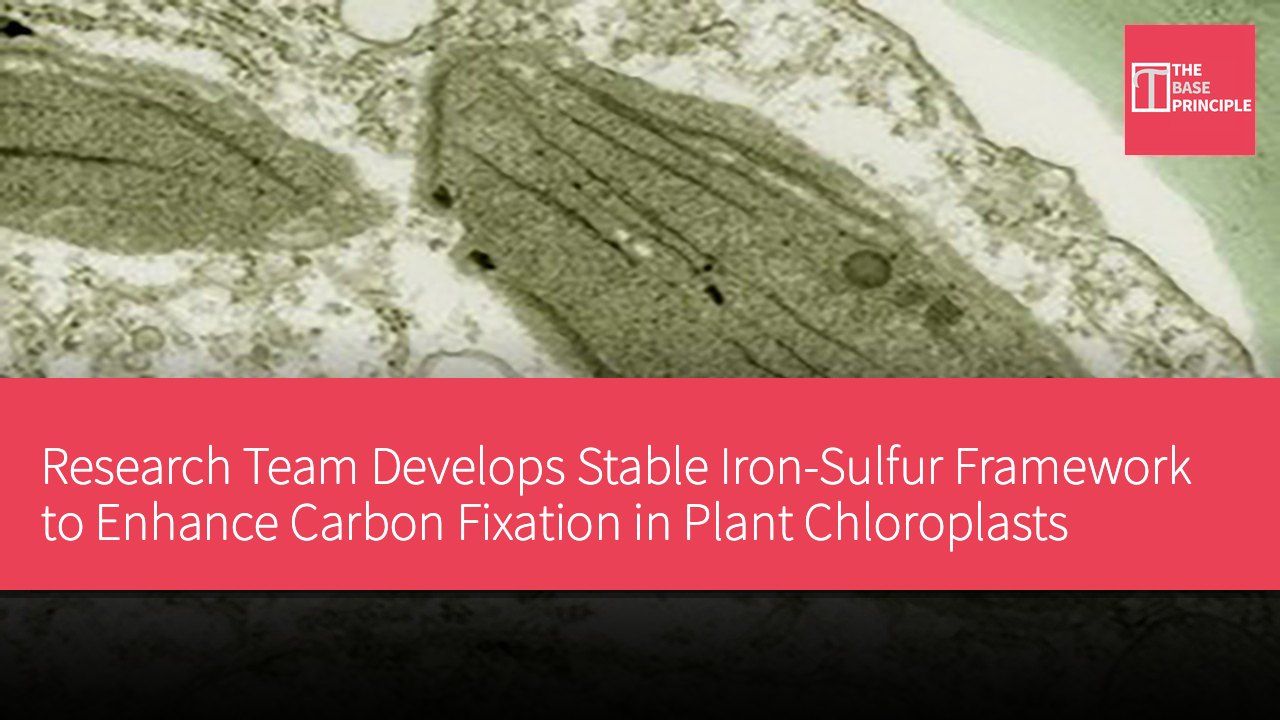
- The organic iron-sulfur framework developed by the research team can enhance carbon fixation ability.
- OISF exhibits higher redox activity than traditional iron-sulfur minerals.
- The carbon fixation activity significantly increases when OISF is combined with chloroplasts.
- The research still has limitations and does not provide complete experimental data.
Researchers at the Beijing Institute of Biophysics have established a stable laboratory-synthesized iron-sulfur cluster framework capable of enhancing the carbon fixation ability of isolated plant chloroplasts, according to a release from the Chinese Academy of Sciences. This work was assisted by the Institute of Genetics and Developmental Biology. Iron-sulfur clusters are small combinations of iron and sulfur atoms found within many proteins that facilitate electron transfer during photosynthesis. Their instability and sensitivity to oxygen have long hindered practical applications. The material developed by the team is called the organic iron-sulfur framework (OISF), which combines these clusters with the stable structure of metal-organic frameworks (MOFs), a type of scaffold formed by metal atoms connected to carbon-based molecules.
The researchers published their findings on October 30 in the journal Small. The team led by Gao Lizeng collaborated with Liu Cuimin's team from the Institute of Genetics, with both researchers serving as co-corresponding authors. PhD student Cao Haolin is a co-first author.
Establishing Clusters That Can Survive in Air
According to the published paper, the team employed hydrothermal synthesis techniques to grow materials in hot water. By adding terephthalic acid, a carbon-based linking molecule, they disrupted the tight lattice of conventional iron-sulfur minerals, resulting in nanosheets capable of maintaining separated clusters. X-ray diffraction, synchrotron radiation, and Mössbauer spectroscopy confirmed the structure and its core, composed of two iron and two sulfur atoms, labeled as [2Fe-2S]. The material provides electrons to test molecules, and the chemical conditions regulate this behavior. Structural analysis links electron transfer to dynamically formed sulfur-sulfur bonds in adjacent layers.
Redox Activity of OISF
Compared to traditional iron-sulfur minerals, OISF exhibits higher redox activity, meaning it is more adept at electron exchange and performs well in the presence of oxygen. This makes it suitable for biological applications.
Charge mobility is a recurring challenge in solar fuel research. A team from the University of Basel reported a tetravalent molecule in 2025, while researchers at Yale University reported an artificial leaf in June that can convert carbon dioxide into methanol. The work from this research institute targets the mechanisms in living plants.
What Happens Inside the Chloroplasts
Effects of OISF Combined with Chloroplasts
The researchers mixed OISF with isolated chloroplasts, which are the parts of plant cells where photosynthesis occurs. According to the release, this combined system demonstrated higher carbon fixation activity than chloroplasts alone. The Chinese version mentions that after 24 hours, carbon fixation activity increased by 1.54 times. The team suggests that OISF may provide electrons to the dark reactions, the stage where carbon dioxide is converted into sugars. Researchers at the University of Liverpool took a different approach in 2023 by placing engineered carboxylates in tobacco chloroplasts. Spraying OISF on spinach leaves also promoted growth, as noted in both the Chinese version and the summary.
However, the study still has several limitations. The results for carbon fixation come from isolated chloroplasts rather than whole plants, and the growth results for spinach did not include yield data. Neither the English nor Chinese institutional releases provided sample sizes or error ranges. The Chinese release reported a 1.54-fold increase in carbon fixation activity after 24 hours, but it did not clarify whether this represents a final activity level that is 1.54 times the control or a relative increase of 154% compared to the control. The next steps mentioned in the Chinese version involve mapping the role of OISF in the photosynthetic electron chain, laying the groundwork for future applications in agriculture.
Potential Impact of OISF on Plant Photosynthesis
The development of the organic iron-sulfur framework (OISF) is significant for enhancing the carbon fixation ability of plant chloroplasts. This research demonstrates the superior performance of OISF in oxygen environments, potentially providing new directions for future biological applications. While current experimental results indicate an increase in carbon fixation activity, further studies are needed to determine its application potential and long-term effects in whole plants. These findings may offer a new technological foundation for sustainable development in the agricultural sector.