
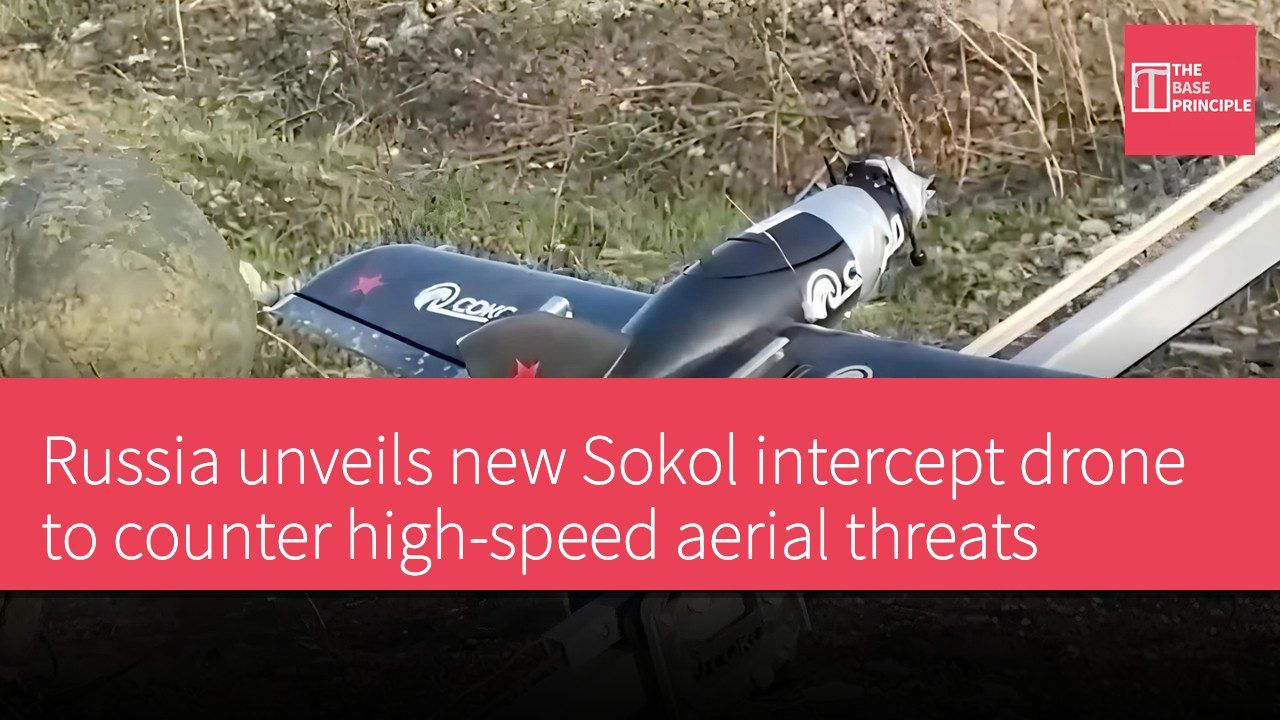
- Russia has launched the Sokol-3 intercept drone to counter aerial threats.
- Sokol-3 is an evolved version of the Sokol-I, faster and with design improvements.
- The actual performance of the new drone has not been independently verified.
- The intercept drone offers a cost-effective defensive solution.
Russia has launched a new version of its Sokol intercept drone, claiming that the system can address faster aerial threats, including jet drones, as part of the country's efforts to bolster defenses against Ukrainian drone attacks. The Russian Ministry of Defense stated on November 12 that a Sokol-3 drone unit from the Tsentr forces intercepted a high-speed Ukrainian strike drone in the Dnipropetrovsk direction. The department released footage of the system in operation, describing the aircraft as an interceptor designed to destroy incoming unmanned aerial vehicles.
This announcement coincided with the appearance of the Sokol-3 in Russian military media, where officials highlighted its claimed ability to intercept jet targets. However, publicly available footage and reports have not independently verified the system's success in intercepting jet drones, nor is there evidence that it has intercepted manned jet aircraft.
Design and Performance of Sokol-3
The Sokol-3 appears to be an evolved version of Russia's earlier Sokol-I interceptor, which has been used against Ukrainian reconnaissance and attack drones. The Sokol-I is a relatively simple fixed-wing drone that uses a forward-facing camera and controlled flight to locate and intercept aerial targets. Russian military reports have described its use against several types of Ukrainian drones, including Leleka, Blyskavka, and Hornet. According to a Russian officer, the Sokol-3 is about half the size of its predecessor but has double the speed.
It has also been reported to be equipped with different warheads, indicating a design intent to improve its capability against smaller or faster-moving targets. Images of the new drone show it has a conventional fixed-wing configuration, with a rear propeller, straight wings, and movable control surfaces. Unlike the manually launched Sokol-I, the Sokol-3 appears to employ a catapult launch system, allowing for takeoff without a runway.
Russia has yet to disclose independent verifiable specifications for the new interceptor, including its maximum speed, endurance, operational altitude, detection range, or warhead characteristics. The need for faster intercept drones arises as both Russia and Ukraine face increasingly rapid drone challenges. Traditional propeller-driven reconnaissance and attack drones can be intercepted by relatively inexpensive systems, but faster jet variants shorten the detection and interception time. According to a Reuters report from September 2026, Russia has significantly increased its use of jet attack drones, with Ukrainian military data showing a substantial rise in the number of drones launched in the summer reaching speeds of approximately 240–500 kilometers per hour.
The slower propeller-driven designs of these aircraft are more difficult to intercept, leading to a growing demand for defensive systems capable of quickly reaching targets, while still costing far less than traditional surface-to-air missiles. Intercept drones offer a potential solution.
Defensive Significance of Intercept Drones
Defenders can use smaller drones to track and destroy threats approaching the front lines without relying on expensive missile systems for every incoming drone. By design, these drones can destroy targets through direct impact or explosive warheads. Russia has already deployed the Sokol-I as part of this approach. Its updated version, the Sokol-3, appears aimed at addressing faster aerial threats, although its actual performance remains unclear. If the Sokol-3 can indeed intercept jet drones, it would hold significant implications.
This type of target requires higher interception speeds, effective target tracking, and sufficient maneuverability to shorten the engagement window. However, the latest statement from the Russian Ministry of Defense only claims that the system destroyed high-speed strike drones, without specifying the type of aircraft intercepted, providing flight data, or proving the targets were jets.
This distinction is important because being able to intercept fast drones does not automatically translate to the ability to intercept manned fighter jets. These are very different categories of targets, with varying speeds, maneuverability, sensors, and defensive capabilities. So far, the Sokol-3 seems to represent Russia's efforts to develop faster tactical anti-drone aircraft. Whether it can reliably intercept jet drones will depend on the results of further testing and independent evaluations.
Item Specifications Speed About twice that of Sokol-I Size About half that of Sokol-I
Impact of Sokol-3 on the Russia-Ukraine Conflict
The launch of the Sokol-3 reflects Russia's need for rapid interception systems in the face of Ukrainian drone threats. As drone technology advances, traditional defensive measures are becoming inadequate against faster aerial targets. The design of the Sokol-3 aims to enhance interception capabilities, particularly against jet drones, which could alter defensive strategies on the battlefield. Although independent verification is still pending and its actual performance requires further testing, if it operates successfully, it could significantly impact the Russian military's anti-drone combat capabilities.