
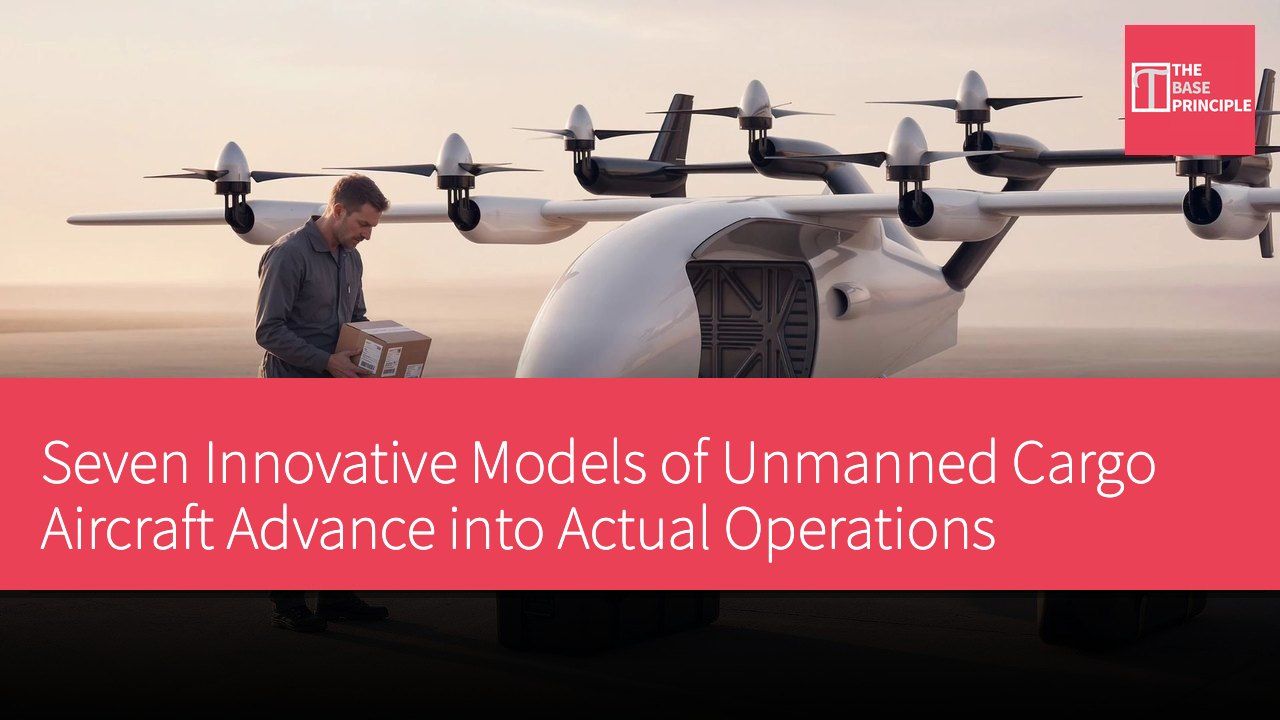
- Unmanned cargo aircraft are gradually achieving commercial operations, delivering medical supplies and packages.
- Elroy Air's Chaparral is an advanced hybrid electric cargo aircraft that does not require a runway.
- Skyways' Skyreach aircraft will begin customer flights in December, featuring long-duration flight capabilities.
- Reliable Robotics is automating the Cessna 208B to reduce pilot demand.
Multiple companies and military organizations are testing unmanned cargo aircraft capable of transporting goods without a pilot. From hybrid electric cargo planes to heavy fixed-wing aircraft, these models are gradually transitioning from concept to practical operation. They have already delivered medical supplies, packages, and military cargo to remote areas. Some have completed unmanned flight demonstrations, while others are still in development. Below are seven groundbreaking models leading this transformation.
Elroy Air's Chaparral is one of the most advanced projects in this category. This hybrid electric aircraft utilizes vertical takeoff and landing propellers, requiring no runway, while a separate propulsion system supports forward flight. It is designed to carry over 500 pounds (227 kilograms) of cargo, with a range of up to 450 miles (724 kilometers). Its modular cargo bay can transport medical supplies, spare parts, and other goods without the need for ground infrastructure at the destination. Chaparral completed a series of automated unmanned cargo flights in September 2026, conducted in Louisiana under the FAA's eVTOL Integration Pilot Program.
The aircraft delivered packages, medical supplies, tools, food, and water under the supervision of air traffic control, without a pilot on board. This demonstration brought the project closer to commercial operations.
Skyways' Automated Cargo Aircraft
Skyways launched its Skyreach automated cargo aircraft in November 2026, with customer flights expected to begin in December. The aircraft is developed based on the company's V3 Block 2 platform, combining eight electric motors for vertical takeoff and fuel-powered propulsion for forward flight. It is designed for over 18 hours of flight time, with an operational range exceeding 1,300 miles (2,092 kilometers) at maximum fuel configuration. Its seven cubic feet (0.2 cubic meters) cargo bay can accommodate various payloads, including temperature-controlled goods.
Skyreach has a total fuel and payload capacity of 100 pounds (45 kilograms), with its maximum range dependent on the amount of cargo carried. The project has received $37 million in funding from the U.S. Air Force's AFWERX STRATFI to support full production. Skyways stated that production has begun in Austin, Texas, following progress in completing production design and flight qualification testing.
Poseidon Aerospace is developing the Egret as a larger alternative to small cargo drones. The aircraft is planned to have a wingspan of approximately 50 feet (about 15 meters) and is designed to transport up to 4,000 pounds (1,814 kilograms) of cargo, with a range exceeding 1,000 nautical miles (1,151 miles). Unlike vertically taking off aircraft, the Egret will utilize conventional runways, including paved and unpaved airport runways. Its design includes front and rear cargo doors to simplify loading and unloading. Poseidon completed a $60 million Series A funding round in September 2026 to advance flight testing and establish its first production line.
The company anticipates that the full-sized aircraft will conduct its first unmanned flight by the end of 2026. An early quarter-scale Seagull demonstrator has already completed flights, helping to validate elements of the aircraft design and control architecture. The Egret is designed to operate autonomously or be remotely controlled, rather than carrying a pilot.
Czech airline Zuri launched its unmanned cargo VTOL aircraft in August 2026. This hybrid electric tiltrotor is designed to combine the vertical takeoff capability of helicopters with the efficiency of fixed-wing flight. Its planned payload is 165 kilograms (364 pounds), including fuel and cargo. Zuri estimates the design range to be 679 kilometers (422 miles), or 569 kilometers (354 miles) with 30 minutes of fuel reserve, at a cruise speed of approximately 220 kilometers per hour (137 miles per hour).
The aircraft is based on the Technology Demonstrator 2.0, a full-sized platform undergoing ground testing and system integration in Prague. Zuri plans to begin flight testing in early 2027 and has secured €6 million (approximately $6.9 million) in initial Series A funding. Unlike some fully automated designs, Zuri's aircraft will be remotely piloted and will conduct automated missions under ground supervision.
Bell Modifying Helicopters into Drones
Bell, in collaboration with Near Earth Autonomy, is modifying the Bell 505 helicopter into an unmanned logistics aircraft to support the U.S. Marine Corps' Medium Air Supply Vehicle – MARV-EL Phase II program. The project aims to provide the Marine Corps with a medium cargo aircraft capable of delivering supplies to dispersed troops in contested environments. Utilizing an existing helicopter platform provides access to established manufacturing and maintenance infrastructure while allowing the aircraft to operate without a pilot.
Bell announced its decision to participate in this program in April 2026. The development team is integrating Near Earth's Captain automation system and modifying the helicopter's cargo handling capabilities. The plan aims to produce a prototype aircraft that meets or exceeds the Marine Corps' performance requirements. The aircraft is still in development, but its military backing provides clear customer and operational requirements for the project.
U.S. company Reliable Robotics is working to automate the Cessna 208B Grand Caravan, a widely used single-engine turboprop aircraft, rather than developing an entirely new aircraft. The system uses onboard computers, sensors, and automated flight controls to manage operations such as taxiing, takeoff, navigation, and landing. Remote operators can supervise the aircraft from a ground control station, reducing the need for pilots in the cockpit. In October 2026, Reliable Robotics completed a cargo flight demonstration at Albuquerque International Airport as part of the FAA's eVTOL Integration Pilot Program.
These tests utilized a safety pilot on board, and the aircraft was remotely piloted from the company's base in California. Thus, these tests demonstrated automation and remote operation rather than conventional unmanned commercial services. The significance of this project lies in the fact that modifying existing certified aircraft may provide a more direct path to achieving unmanned cargo operations than developing entirely new airframes.
Textron Aviation, in collaboration with automation developer Merlin, introduced the Cessna SkyCourier UX concept in September 2026. This concept combines the existing twin-engine SkyCourier aircraft with Merlin's Pilot automated flight software to explore cargo operations without crew members. The aircraft is expected to carry approximately 6,000 pounds (2,722 kilograms) of cargo and accommodate up to three LD3 cargo containers.
It can operate from unimproved runways and support the delivery of goods to remote military bases, expeditionary locations, and other destinations where traditional air transport is difficult to arrange. The concept also explores more fundamental redesigns of the aircraft. Removing the cockpit could free up more space for cargo and consider forward-loading configurations and integrated loading equipment. However, the SkyCourier UX remains a concept under ongoing engineering research and evaluation. Textron and Merlin have not yet announced completed automation prototypes or production plans.
Trends in Unmanned Cargo Aircraft Development
The development of unmanned cargo aircraft demonstrates the potential of technology in the transportation sector, particularly for delivering supplies to remote areas. These aircraft not only enhance transportation efficiency but also reduce reliance on human labor, especially in military and medical applications. As multiple companies invest resources in development, market competition will drive technological innovation, further advancing unmanned technology. In the future, these unmanned aircraft are expected to become a significant component of the logistics industry, transforming traditional cargo transport models.