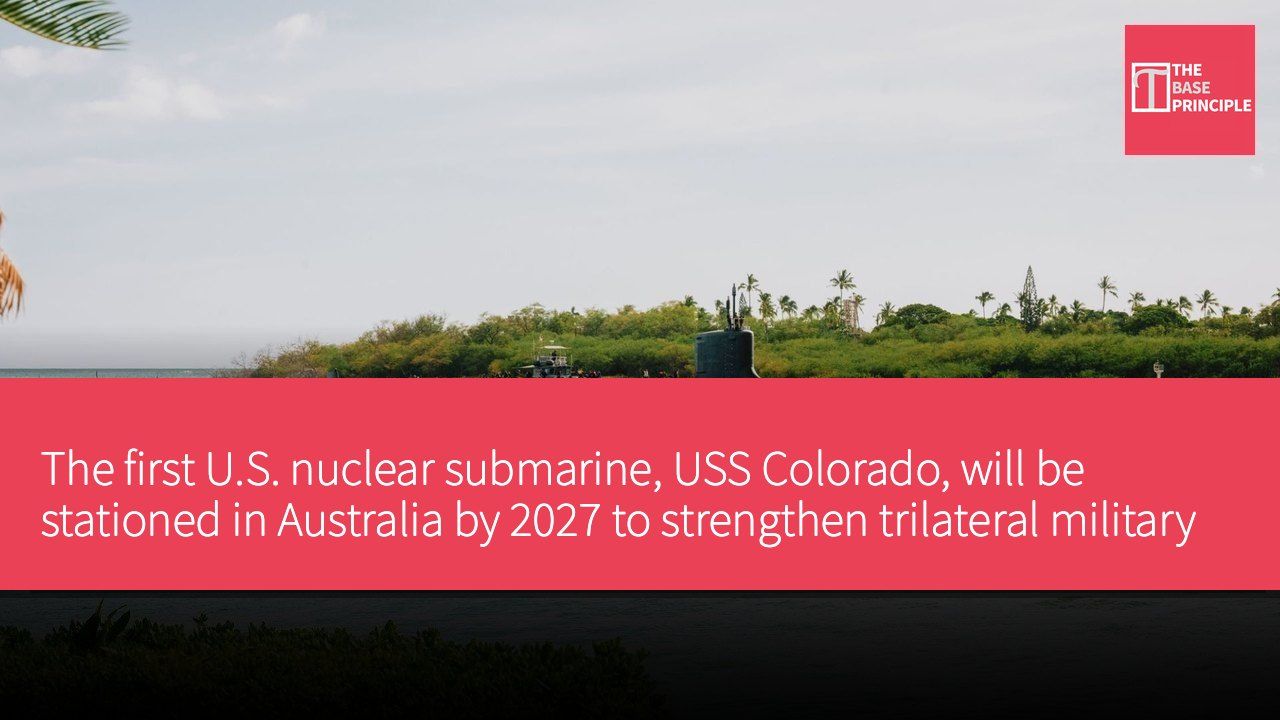
- The USS Colorado will be stationed in Australia by the end of 2027, enhancing trilateral military cooperation.
- This deployment will establish the first submarine assigned to the Submarine Rotational Force-West.
- Australia will enhance its maintenance and support capabilities for U.S. and UK submarines.
- Australia is strengthening its domestic naval technology industry to support submarine maintenance.
Australia will welcome the USS Colorado, the first U.S. nuclear-powered attack submarine under the AUKUS (Australia-UK-U.S.) defense agreement, a move that will enhance military cooperation among the three countries. This deployment marks a significant step in establishing a regular U.S. submarine presence in Australia and expands the collective deterrent capability of the three nations in the Indo-Pacific region. The agreement aims to bolster Australia's naval capabilities while deepening defense ties with the U.S. and the UK. This initiative comes amid growing regional security concerns over China's military expansion, reflecting allies' efforts to maintain strategic balance in the area.
Deployment and Function of USS Colorado
In expanding submarine presence, Australia will receive the USS Colorado by the end of 2027, a Virginia-class fast attack submarine of the U.S. Navy, as the three AUKUS partner countries enhance their undersea warfare capabilities. This deployment will establish the first submarine assigned to the Submarine Rotational Force-West (SRF-West), which is planned to operate from HMAS Stirling base in Western Australia. This arrangement aims to strengthen submarine operations in the Indo-Pacific region while helping Australia develop the technical expertise and infrastructure needed to operate and maintain its nuclear-powered submarines.
It will also expand regional maintenance and support options for U.S. and UK submarines.
The USS Colorado (SSN 788) is 115 meters (380 feet) long and is designed for undersea warfare, surveillance, and land attack missions as a Virginia-class fast attack submarine. The submarine is equipped with land-attack missiles and advanced torpedoes, capable of striking targets both underwater and on land. The U.S. Navy officially commissioned the submarine in March 2018, and its assignment to SRF-West represents a significant step in establishing a regular rotation of U.S. nuclear submarines at Australian naval facilities. According to plans, HMAS Stirling will eventually rotate up to four U.S. fast attack submarines and one UK fast attack submarine.
These submarines will not be permanently stationed at the facility but will rotate as part of the trilateral defense cooperation. This deployment will also enhance Australia's readiness to support allied submarines.
Enhancement of Australia's Submarine Maintenance Capabilities
The maintenance period for U.S. submarines is scheduled to begin later this week, demonstrating Australia's growing capability in maintaining U.S. and UK nuclear-powered fast attack submarines. Australian Deputy Prime Minister and Defense Minister Richard Marles stated that the initiative is progressing well, with U.S. personnel preparing the site at HMAS Stirling. SRF-West aims to assist Australia in developing the expertise and infrastructure necessary to operate, maintain, and regulate its nuclear-powered submarines. While these submarines will carry conventional weapons, their nuclear propulsion systems require specialized technical skills, trained personnel, and dedicated facilities.
The rotational force will also expand maintenance options for AUKUS partners, supporting submarine deployments and helping to sustain advanced underwater platforms in the Indo-Pacific region.
According to government forecasts, Australia's submarine program could cost up to $235 billion over the next 30 years. The three partner countries have stated that activities under SRF-West will comply with their international obligations, including the Treaty on the Non-Proliferation of Nuclear Weapons. Australia will also adhere to the South Pacific Nuclear Free Zone Treaty, known as the Rarotonga Treaty. Meanwhile, Australia is strengthening its domestic naval technology industry. The French defense group Thales has opened a sonar facility in Rydalmere, western Sydney, dedicated to manufacturing and maintaining towed array sonar systems for military submarines, vessels, and other maritime platforms.
The facility is co-funded by Thales Australia and the Australian government and will provide sonar systems for the Hobart-class destroyers, Collins-class submarines, and BlueSentry autonomous systems.
Towed array sonar uses sensors deployed behind vessels to detect and track underwater acoustic signals, supporting maritime surveillance and submarine detection. Local production and maintenance are expected to reduce reliance on overseas facilities, shorten overseas maintenance times, and extend deployment durations. Thales holds approximately 35% of Naval Group, the French defense contractor that lost Australia's submarine contract in 2021 due to Canberra's pivot to AUKUS.
Impact of USS Colorado Deployment on Regional Security
The deployment of the USS Colorado to Australia is a significant milestone in the AUKUS agreement, reflecting the three nations' commitment to regional security. As concerns over China's military expansion grow, this action will enhance collective deterrent capabilities in the Indo-Pacific region. The enhancement of Australia's submarine maintenance capabilities indicates that its role in international defense cooperation will become increasingly important and will help maintain strategic balance in the region. With advancements in submarine technology, Australia is also working to establish its own naval technology industry, further enhancing its defense autonomy.