
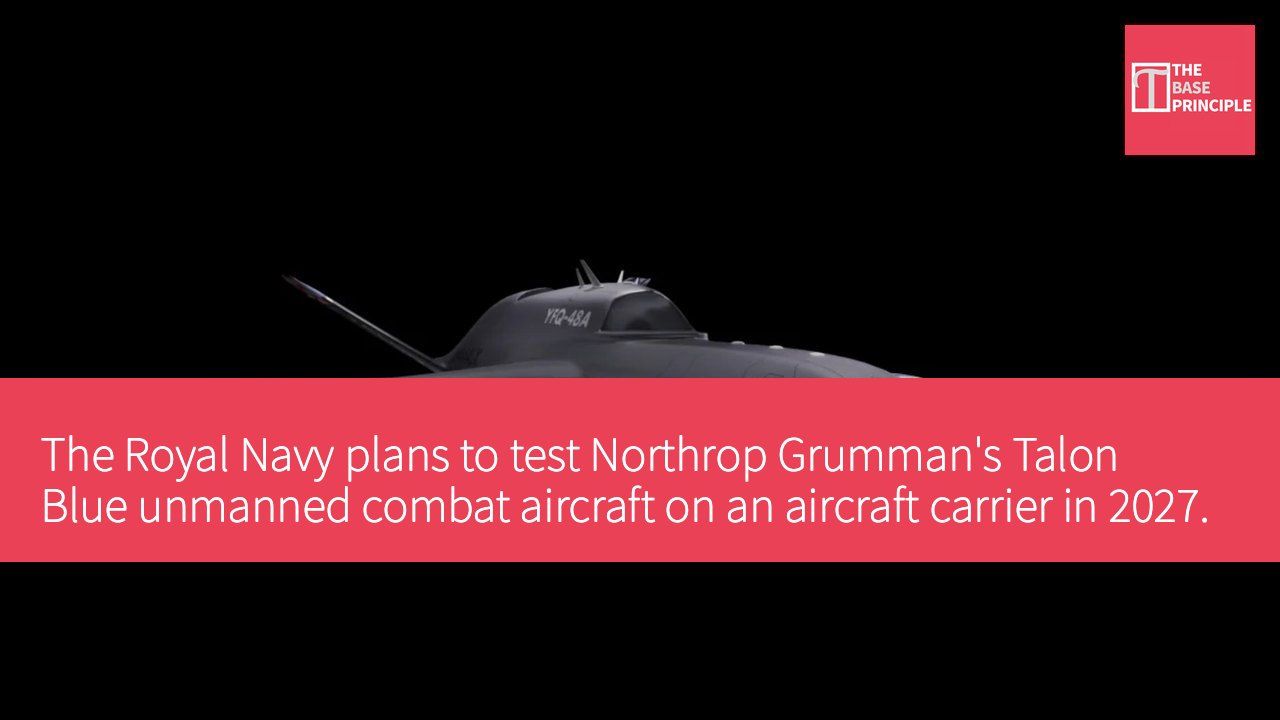
- The Royal Navy plans to test the Talon Blue unmanned combat aircraft in 2027.
- The trial will take place under the "Project Vanquish," demonstrating the carrier operations of autonomous aircraft.
- Talon Blue is positioned as a low-cost autonomous platform aimed at simplifying the development of combat aircraft.
- The introduction of collaborative combat aircraft may expand the mission scope of carrier-based air formations.
The Royal Navy plans to showcase Northrop Grumman's Talon Blue Collaborative Combat Aircraft (CCA) drone on a British aircraft carrier next year. This proposed trial marks a significant step towards integrating carrier-based unmanned combat aircraft into the Royal Navy's aviation capabilities. Northrop Grumman has confirmed the plan, stating it will collaborate with the Royal Navy over the next 12 months to prepare for the demonstration. This trial may also open new opportunities for Talon Blue, which was announced to have its first flight last month.
Importance of Drone Testing
The Royal Navy plans to test Northrop Grumman's Talon Blue Collaborative Combat Aircraft (CCA) drone on a British aircraft carrier in 2027. This proposed demonstration will signify a major advancement in introducing jet-powered unmanned combat aircraft into the Royal Navy's aviation operations. The trial will be conducted under "Project Vanquish," a Royal Navy initiative aimed at demonstrating the launch and recovery of autonomous aircraft from its Queen Elizabeth-class aircraft carriers. The project seeks to determine whether unmanned combat aircraft can operate from the ship without the need for catapults or arrestor wires, according to The War Zone.
The two British aircraft carriers, HMS Queen Elizabeth and HMS Prince of Wales, are configured for Short Takeoff and Vertical Landing (STOVL) operations. Unlike traditional aircraft carriers, they do not have the catapult systems or arrestor wires required for launching and recovering conventional fixed-wing aircraft. "Project Vanquish" was first announced in September 2025. Its primary goal is to demonstrate the operation of secondary autonomous collaborative platforms (ACP) from the aircraft carrier. These aircraft are typically designed to lower costs to enable higher-risk missions while still possessing the capability to perform useful military tasks, even in the event of acceptable losses.
Talon Blue, referred to by the U.S. military as YFQ-48A, was officially unveiled in December 2025. Northrop Grumman announced its first flight in October 2026, marking a significant milestone in the development of this autonomous aircraft. The company positions Talon Blue as a low-cost autonomous platform aimed at reducing the time and cost associated with developing and deploying combat aircraft. However, its actual unit cost and detailed performance specifications have not been publicly disclosed. The potential carrier operations of the aircraft may require further development.
Although the Queen Elizabeth-class aircraft carriers do not require catapult-assisted launches or arrestor recoveries for this demonstration, Talon Blue may need modifications or a dedicated naval variant to operate safely on their decks.
Advancing the Hybrid Navy Concept
The Royal Navy has already tested several drones on its aircraft carriers, including General Atomics' Mojave drone and Tekever AR5, which were also demonstrated onboard in November 2026. Both drones are propeller-driven platforms, with technology that is relatively simpler compared to the jet-powered Talon Blue. The service has also experimented with small drones, including a disposable attack system launched via a trailer-mounted catapult. These trials are part of a broader effort to integrate autonomous aircraft as well as unmanned surface and underwater platforms into naval operations.
The Royal Navy refers to this approach as the "Hybrid Navy" concept, which aims to combine manned warships and aircraft with increasingly capable autonomous systems.
The introduction of collaborative combat aircraft may expand the mission scope of carrier-based air formations. The planned demonstration may also provide Northrop Grumman with valuable experience in carrier-based automation. The company is separately developing a conceptual carrier-based CCA design for the U.S. Navy. Therefore, successful trials in British waters could offer insights into operating unmanned jet aircraft on carriers lacking traditional launch and recovery equipment. However, the proposed demonstration in 2027 remains an early step in establishing such capabilities.
Impact of Unmanned Combat Aircraft on Naval Operations
The introduction of the Talon Blue unmanned combat aircraft marks a significant advancement for the Royal Navy in carrier aviation capabilities, particularly in operating autonomous aircraft without traditional launch and recovery equipment. This not only reduces operational costs but also enhances the flexibility and efficiency of mission execution. As the Navy increasingly relies on automated systems, this test will provide valuable insights for future developments in carrier-based automation and may influence naval strategies in other countries.