
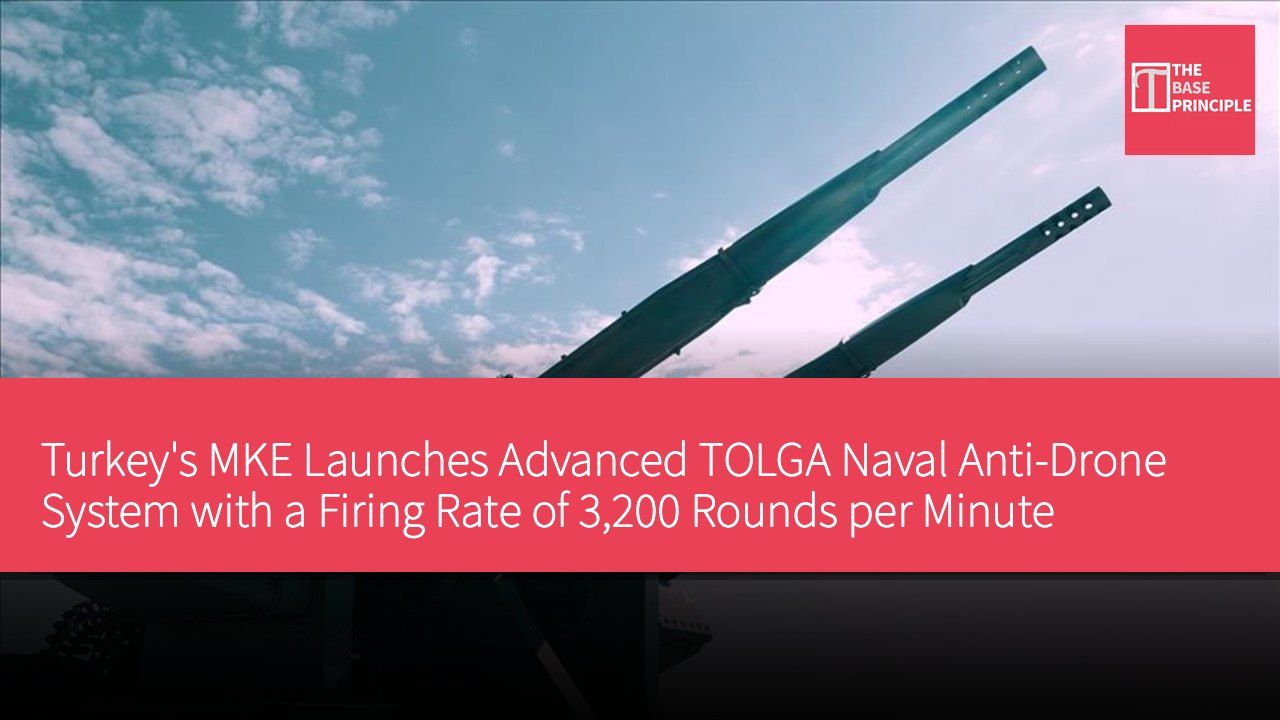
- The TOLGA system is designed to protect naval vessels and commercial ships from drone attacks.
- The system can achieve a firing rate of up to 3,200 rounds per minute.
- The TOLGA design accounts for the erratic movements of drones, featuring efficient tracking capabilities.
- The system successfully tracked and engaged targets during the TURNAs-2026 exercise.
Turkish defense company Makine ve Kimya Endüstrisi (MKE) has recently unveiled its advanced TOLGA naval anti-drone system. This system was showcased at the renowned Euronaval 2026 maritime exhibition in Paris and is a locally produced Close-In Weapon System (CIWS) aimed at protecting naval vessels and commercial ships from aerial loitering munitions and unmanned surface vessels. These unmanned systems represent the latest asymmetric threats on the modern battlefield.
Design Features of the TOLGA System
The TOLGA features a dual 20mm automatic cannon system that allows for flexible firing of either single or dual barrels based on target and mission requirements. This design is intended to counter swarm attacks from drones and other unmanned vessels, providing maximum coverage.
When activated simultaneously, MKE notes that the TOLGA can achieve a firing rate of up to 3,200 rounds per minute. Additionally, these turrets utilize unique fragmentation munitions that create lethal clouds of debris upon impact to destroy these small, agile drones. According to MKE, the effective range of the TOLGA anti-drone weapon system can reach 3,281 feet (approximately 1,000 meters). The turret module has a ready-to-fire magazine capacity of 600 rounds, with each weapon holding 300 rounds, as reported by leading defense intelligence firm Janes.
The physical turret of the TOLGA has been optimized to account for the erratic movements of drones, relying on a fully stabilized platform and equipped with an independent electro-optical (EO) sensor suite that enables target optics to track incoming threats regardless of the orientation of the gun barrels. Its elevation range spans from -30 degrees to +70 degrees, with a lateral speed of approximately 60 degrees per second, allowing it to depress the gun barrels at extreme angles to engage low-flying surface drones while maintaining rapid lateral tracking speeds to follow fast-moving surface drones.
Results of Live-Fire Exercises
MKE recently conducted a rapid maritime feasibility validation of the TOLGA system. The naval version of the weapon system underwent live-fire exercises during the TURNAs-2026 drill in late October, successfully tracking and engaging aerial and maritime drone targets while installed on the Turkish Navy's TCG Beykoz frigate. Reports from the manufacturer indicate that the system performed exceptionally well during this exercise.
The architecture of the TOLGA features modular characteristics built on the foundation established by MKE itself. In November 2025, the company also disclosed dedicated 12.7mm anti-drone ammunition. Furthermore, weapon stabilization and intelligent targeting technologies related to the TOLGA program have already been applied to the BMP-1T TURAN infantry fighting vehicle, co-produced by Turkey and Azerbaijan.
Strategic Significance and Applications of the TOLGA System
The launch of the TOLGA system marks a significant advancement for Turkey in drone defense technology. With the rapid development of drone technology, traditional naval vessels face increasing threats, and TOLGA provides an effective solution to counter these emerging asymmetric threats. Its high firing rate and flexible design enable it to operate in various combat environments, enhancing the naval defense capability. The success of the live-fire exercises further validates the system's practicality and reliability, demonstrating Turkey's autonomous innovation capabilities in defense technology.