
- Ursa Major has received a $10.9 million contract to continue developing the Draper liquid rocket engine.
- The Draper engine is designed to store liquid propellants suitable for supersonic applications.
- This engine features adjustable thrust and multiple restart capabilities, enhancing controllability.
- The latest funding supports Ursa Major's promotion to propulsion frameworks for test vehicles and future weapons.
U.S. propulsion company Ursa Major has secured a $10.9 million contract option from the Air Force Research Laboratory (AFRL) to continue developing its Draper liquid rocket engine, following two experimental missile demonstration flights of the system. This funding will advance the development of the Draper engine, which is designed for supersonic applications and uses storable liquid propellants. The latest award builds on a $28.6 million AFRL contract announced in May 2025, under which Ursa Major was tasked with maturing the engine and integrating it into a flight demonstrator.
Advantages of the Draper Engine Design
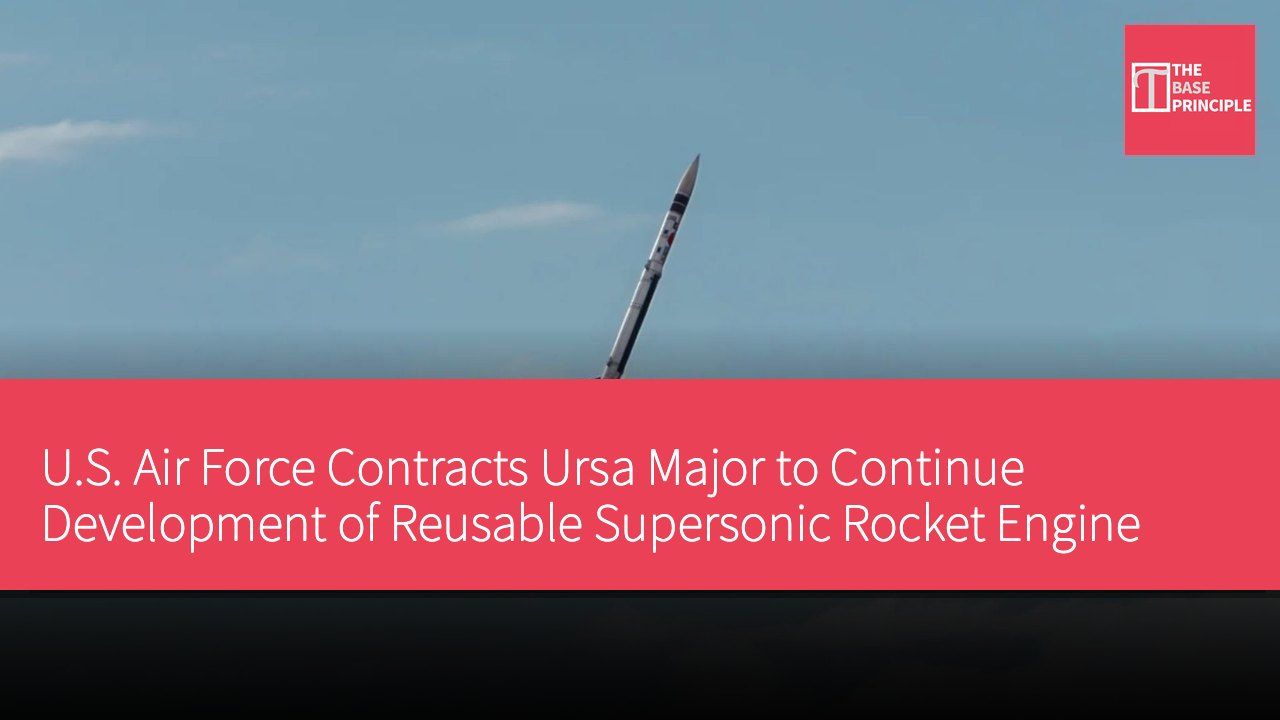
The new option was awarded following the successful flight of the economic rapid missile demonstrator (ARMD) using Draper as its propulsion system. AFRL and Ursa Major first announced the flight demonstration in March 2026, reporting that the vehicle achieved supersonic speeds. A follow-up flight occurred about 45 days later, extending the demonstrator's flight envelope and testing the engine's performance and control during different flight phases. These flights are significant development milestones but should not be confused with publicly confirmed supersonic flight.
AFRL described the March demonstration as supersonic, with the broader goal of the program being to develop propulsion technologies for future hypersonic weapons and test vehicles.
The use of storable liquid propellants in the Draper engine is due to its design, which aims to combine certain operational advantages of solid rocket motors with the controllability of liquid propulsion. According to Ursa Major, the engine can produce approximately 4,000 pounds of thrust and uses hydrogen peroxide and kerosene in a closed catalyst cycle. Unlike cryogenic propellants that require specialized temperature-controlled storage, the propellants for Draper can be stored at room temperature. The company states that these propellants can remain stable for years, allowing the vehicle to be ready for launch without the need for prior loading or conditioning of the fuel.
The engine also features adjustable thrust capabilities, meaning its thrust can be modified as needed during flight. According to the company, Draper can also be restarted multiple times. These features provide greater control than traditional solid rocket motors, which typically burn at a predetermined rate once ignited. This flexibility is particularly useful for hypersonic test vehicles that require variable speeds and maneuverability to replicate advanced threats. It also supports greater control of propulsion for future tactical weapons during flight.
Future Applications of the Propulsion System
The ARMD program aims to demonstrate the speed of developing, integrating, and flying a new propulsion system and missile-like vehicles. Ursa Major states that the first flight of the ARMD vehicle will occur about eight months after the contract begins, with the second flight showcasing rapid turnaround between missions. Draper also plays a central role in the company's broader supersonic product portfolio. In February 2026, Ursa Major unveiled the HAVOC missile system, describing it as a medium-range supersonic weapon powered by the Draper engine.
The company states that HAVOC can adjust thrust and restart during different flight phases and is designed for potential launches from aircraft, ships, and ground systems. These are the claimed design capabilities of the company, not evidence that the weapon has entered actual service. Ursa Major is also developing the Hadley liquid rocket engine, which has powered Stratolaunch's Talon-A2 supersonic test vehicle. The company reported in April 2026 that Hadley has completed 10 successful flights, including missions at sustained supersonic speeds.
Thus, the latest AFRL funding supports not just an isolated engine development effort but advances a propulsion framework that Ursa Major hopes to promote for test vehicles and future weapons. However, the $10.9 million award remains a development milestone. The company and AFRL have not publicly disclosed a deployment timeline for weapons powered by Draper, and the latest announcement does not establish that HAVOC is ready for deployment.
Ursa Major's Technological Breakthroughs and Their Impact
Ursa Major's Draper liquid rocket engine not only has the potential for supersonic applications but also combines the advantages of solid and liquid propulsion, enhancing operational flexibility. The adjustable thrust and restart capabilities provide greater control in hypersonic weapon testing, which is crucial for the development of future tactical weapons. With AFRL's funding support, Ursa Major's technology will contribute to advancing test vehicles and could transform the propulsion architecture of future weapons, strengthening the U.S. competitive edge in supersonic technology.