
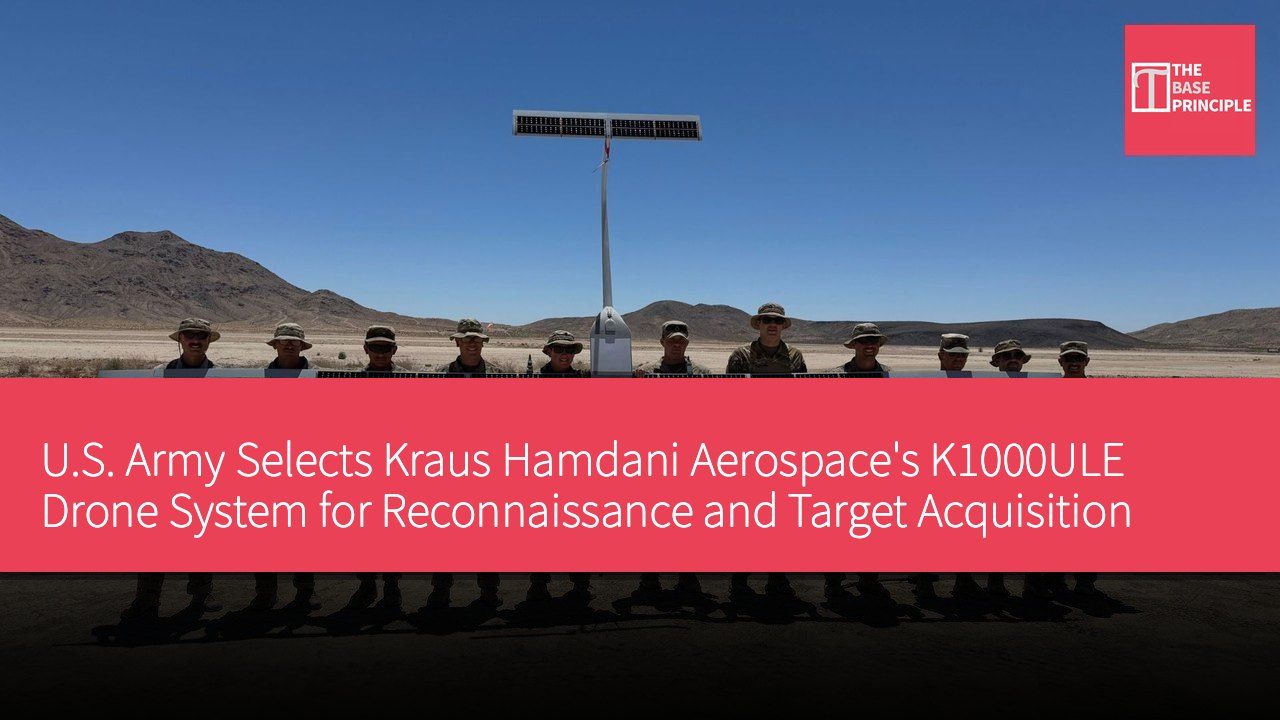
- The U.S. Army has chosen KHA's K1000ULE drone for reconnaissance missions.
- The K1000ULE is designed for rapid deployment in challenging environments and is easy to operate.
- This drone boasts a flight endurance of up to 24 hours and a range of 1,000 miles.
- KHA's product development has been influenced by feedback from soldiers in the field, enhancing performance.
The U.S. Army has selected Kraus Hamdani Aerospace (KHA) to provide its K1000ULE drone system as part of a significant formal project plan. Under the contract, the automated drone will be integrated into military reconnaissance and surveillance operations, supporting on-site target acquisition missions. The California-based company will supply its second-generation, all-electric platform to Army units. These multi-mission aircraft feature vertical takeoff and landing (VTOL) capabilities, allowing troops to launch and recover them without the need for runways.
Design Advantages of the K1000ULE
Stefan Kraus, Chief Technology Officer and co-founder of Kraus Hamdani Aerospace, stated, "Our K1000ULE design revolves around a fundamental operational need—maintaining critical capabilities in the air for extended periods while reducing the burden on the troops using these devices." Traditional fixed-wing drones require long runways for operation; in contrast, the K1000ULE is designed for rapid deployment in harsh and contested areas. According to the company, operating the system does not require a large team, as it can be easily managed on-site by just three people.
The aircraft's aerodynamic design allows it to sustain flight for up to 24 hours on a single charge. During this time, it can cover a range of 1,000 miles (1,609 kilometers). Its cruising speed is 46 miles per hour (40 knots), and it can reach a service ceiling of 20,000 feet. Despite its impressive endurance, the platform remains compact and lightweight, with a fuselage length of 9.8 feet (3 meters), a wingspan of 16.4 feet (5 meters), and a maximum takeoff weight of 42.5 pounds (19.3 kilograms).
The drone employs artificial intelligence for autonomous flight and can operate beyond the operator's line of sight. Its open architecture also allows engineers to update sensors and payloads in response to changing battlefield requirements.
Personal Significance of the Contract
KHA has spent 11 years developing long-range, AI-driven aviation systems. The company has continuously refined the K1000ULE through years of military exercises and real-world deployments. Direct feedback from soldiers in the field has influenced its durability and performance. The U.S. military's decision is based on a recent series of defense milestones achieved by the company. Earlier this year, the U.S. Air Force Central Command awarded KHA an indefinite delivery, indefinite quantity contract. The aircraft has also been included in the Defense Innovation Unit's Blue UAS list and selection list, which reviews safe drone technologies for federal use.
It can be procured through the Army's acquisition marketplace. Subsequently, the company also secured a contract for 2024 to develop and produce ultra-long-endurance drones for the U.S. military.
For the company's leadership, the timing of this contract announcement—shortly after Veterans Day—holds personal significance. Fatema Hamdani, CEO and co-founder of KHA, stated, "Our goal is to save lives and connect the world, which has always guided the products we build and the reasons behind them. The timing of this announcement, coming after Veterans Day, is particularly meaningful for our team. Many of our team members are veterans, and their service, experiences, and commitment have shaped the systems we deliver to those currently serving."
Impact of the K1000ULE on U.S. Military Operational Capability
The selection of the K1000ULE drone underscores the U.S. military's emphasis on efficient reconnaissance technology. This drone not only possesses the capability for extended flight but can also operate without the need for runways, which is crucial in dynamic battlefield environments. Additionally, the system's open architecture design allows it to flexibly respond to various battlefield demands, providing significant tactical advantages for future military operations. KHA's long-term development and integration of field feedback have further enhanced the product's reliability and performance, which is vital for improving the operational efficiency of the U.S. military.