
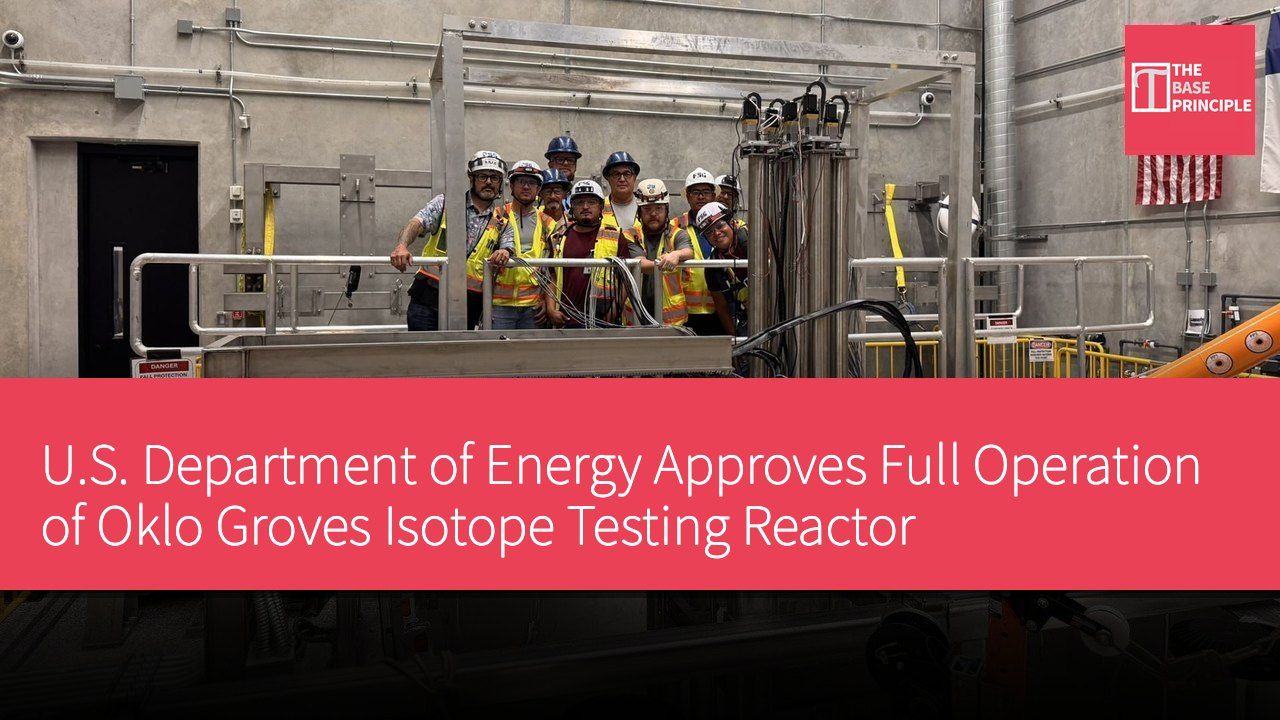
- Oklo Groves isotope testing reactor receives full operational approval.
- Groves-1 will be used for operator training and evaluation of critical hardware.
- The facility will support isotope production and streamline the medical supply chain.
- Oklo has made progress on multiple regulatory milestones, advancing the nuclear industry.
The U.S. Department of Energy (DOE) has overcome the final operational hurdle for the Oklo Groves isotope testing reactor. This decision allows the advanced nuclear company to begin unrestricted research, testing, and personnel training at its site in Texas. The facility, known as Groves-1, will serve as a testing ground for future isotope production and Oklo's commercial fast neutron fission reactors (Aurora powerhouses). Oklo CEO and co-founder Jacob DeWitte stated, "It took us less than a year to develop Groves-1 from greenfield to critical status, which is an important demonstration of what our team can accomplish."
"Now, we are using that experience to operate the reactor, test new capabilities, and learn directly from the work," DeWitte added, noting that this practical experience will help develop the teams and systems needed for future projects.
Reactor Operation and Testing
With full authorization granted, Oklo will utilize the reactor to train operators and evaluate critical hardware. During a recent startup process, staff wore eye-tracking glasses to record what they were looking at and for how long. Engineers will use this data to improve the facility's human-machine interface and design better control rooms for future plants. The team will also continue testing to measure the reliability of the control rod drive mechanisms. In addition to hardware aspects, the reactor will support criticality and reactivity benchmark testing. These measurements will validate Oklo's engineering models and may help enhance the fuel performance and power output of existing light water reactors.
Future Isotope Production Plans
The experience gained from Groves-1 will directly influence the anticipated construction of Groves-2 Forge, a pilot plant for isotope production and processing. This facility was selected under the DOE's Nuclear Energy Launch Pad program, aimed at streamlining the historically fragmented medical supply chain. The facility will combine reactor irradiation with onsite thermal pool processing, handling the separation, recovery, packaging, and transportation of isotopes, all under one roof. Its initial focus will be on producing 177 Lutetium, a radioactive isotope used for targeted cancer therapy.
Oklo has made progress on multiple regulatory milestones. The company constructed Groves-1 under the DOE's reactor pilot program. By August 2026—less than a year after breaking ground—the low-power reactor achieved its first critical state, meaning it attained a controlled, self-sustaining nuclear chain reaction. This is the first project under the federal program to reach that milestone on private land. Chimi Zacot, Assistant Secretary for Nuclear Reactor, stated, "The DOE's reactor pilot program has reset the expectations of the nuclear industry regarding how quickly we can advance from advanced reactor designs to demonstrations while maintaining optimal safety standards."
He added, "Success stories like Groves-1's criticality are paving the way for the future."
The approval in Texas adds several regulatory milestones for Oklo. The company previously received the first site use permit for a DOE commercial advanced fission plant, as well as a fuel award from Idaho National Laboratory, and submitted the first customized comprehensive license application for advanced reactors to the U.S. Nuclear Regulatory Commission. Oklo emphasized, "Oklo is also collaborating with the U.S. Department of Energy and national laboratories to develop advanced fuel recycling technologies."
Oklo's Impact on the Nuclear Industry and Future Outlook
The successful operation of Oklo Groves-1 marks a significant advancement in advanced nuclear technology, enhancing the potential applications of nuclear energy and helping to streamline the medical supply chain. With the experience gained from Groves-1, Oklo will be better positioned to develop future isotope production facilities, which are crucial for medical and other applications. Furthermore, Oklo's progress in regulatory matters demonstrates government support for advanced nuclear technologies, potentially fostering more innovation and investment, further advancing the nuclear industry.