
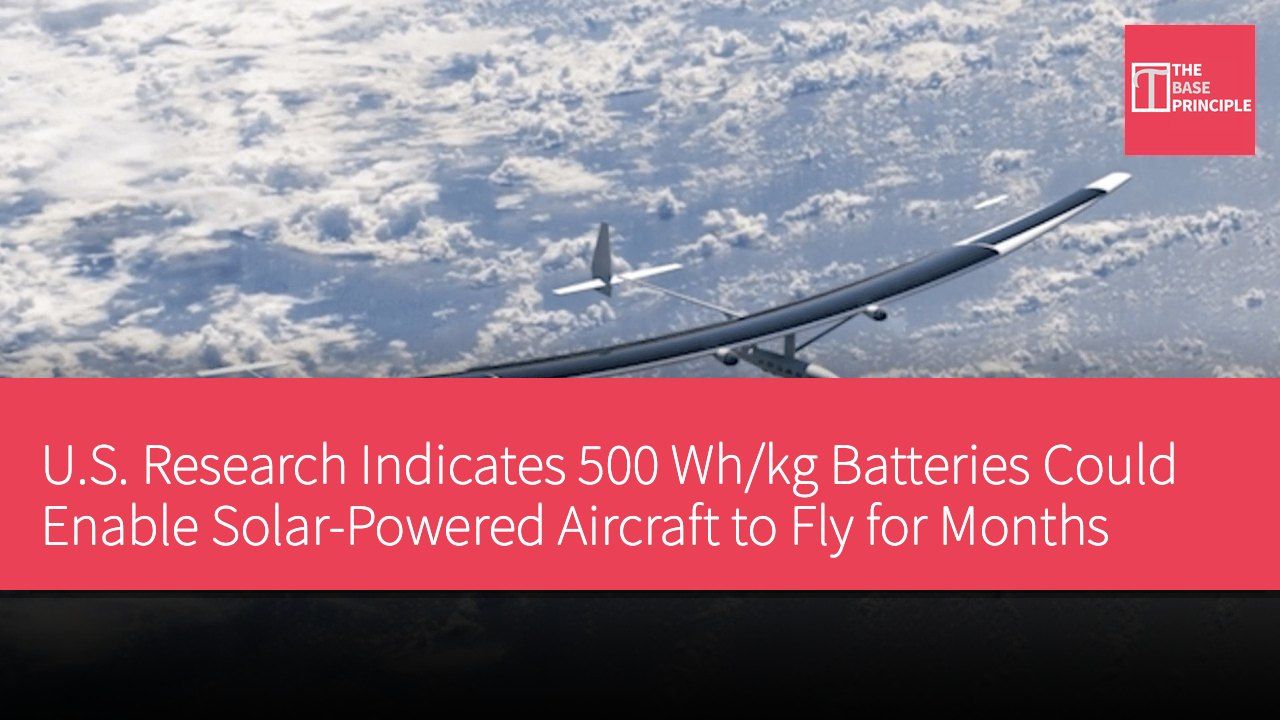
- U.S. research indicates that 500 Wh/kg batteries could enable solar-powered aircraft to fly for months.
- Solar panels provide power during the day, charging batteries to support nighttime flight.
- The challenge of battery weight necessitates prioritizing energy density for sustained flight.
- Solar-powered aircraft could reduce manpower needs and operating costs, providing longer observation times.
After sunset, keeping solar-powered aircraft in the air involves difficult trade-offs: larger batteries store more energy, but their weight causes the aircraft to consume more energy. A new study led by the U.S. has identified a battery performance target that could help unmanned aerial vehicles fly for weeks or months. Their analysis indicates that an energy density of 500 watt-hours per kilogram (Wh/kg) is a critical threshold for sustained solar flight, applicable in regions where atmospheric conditions permit. Such aircraft would operate at approximately 60,000 feet in the stratosphere, collecting observational data for climate research, hurricane tracking, and wildfire monitoring.
Solar panels will power operations during the day and charge the batteries to support nighttime flight.
The Challenge of Battery Weight and Energy Density
The challenge of addressing battery weight is led by Craig Mascarenhas, with the research conducted in the lab of Harvard University meteorologist Jim Anderson. He described the engineering challenge: "It's a circular mathematical relationship; you need more energy storage, but the batteries get heavier, so now you need more energy to push it through the air to get more lift." Researchers believe that the development of batteries for these aircraft should prioritize energy density, which is the ratio of energy stored in the battery relative to its weight.
Power density, or the rate at which energy is released, is less critical here. The energy required for these aircraft is relatively small, but they must carry enough stored energy to sustain flight throughout the night.
The proposed 500 Wh/kg performance target is roughly double the data for commercial electric vehicle batteries, which is about 250 Wh/kg. Experimental and specialized batteries have already reached around 400 Wh/kg, bringing this target closer, although cost remains a barrier. "We are almost there. These batteries are currently very expensive, but prices are dropping rapidly," Mascarenhas stated. These findings set a developmental goal rather than demonstrating a new battery or months-long aircraft mission. Achieving sustained flight also depends on local atmospheric conditions.
Battery researchers Venkatasubramanian Viswanathan and Shashank Sripad also contributed to the analysis. Aviation entrepreneur John Langford's company has built and flown experimental solar-powered aircraft, and he co-authored the paper.
Potential Advantages of Solar-Powered Aircraft
Anderson has worked on the concept of solar-powered aircraft for thirty years and leads Harvard's involvement in the Stratospheric Climate Observing System (SACOS). Its potential advantages lie in continuous observation. According to the provided research report, NASA's manned ER-2 research aircraft typically conduct missions lasting six to eight hours, with flight costs reaching tens of thousands of dollars per hour. Solar-powered aircraft could ultimately revisit the same area continuously over months, potentially reducing manpower needs and operating costs while providing longer observation times. Anderson and Mascarenhas are also guiding research aimed at supporting deep learning and radiative transfer models for wildfire mapping and environmental awareness.
"I am passionate about reducing the damage and destruction caused by wildfires globally. I find the unique capabilities unlocked by this project very exciting," Mascarenhas stated. Researchers from Harvard University's John A. Paulson School of Engineering and Applied Sciences collaborated with the University of Michigan and industry partners to outline this approach in ACS Energy Letters.
Item Specifications Battery Performance Target 500 Wh/kg Commercial Electric Vehicle Battery Performance About 250 Wh/kg Experimental Battery Performance About 400 Wh/kg Flight Altitude About 60,000 feet
Technical Challenges and Prospects for Sustained Flight
As the demand for sustainable aviation technology increases, the development of solar-powered aircraft becomes particularly important. The 500 Wh/kg battery performance target is not only a technical challenge but also a key to future climate monitoring and environmental protection. The success of such aircraft could significantly reduce operating costs and increase the frequency and duration of observations, which is crucial for monitoring global climate change and natural disasters. The researchers' efforts will drive advancements in battery technology, paving the way for future unmanned aerial vehicles.