
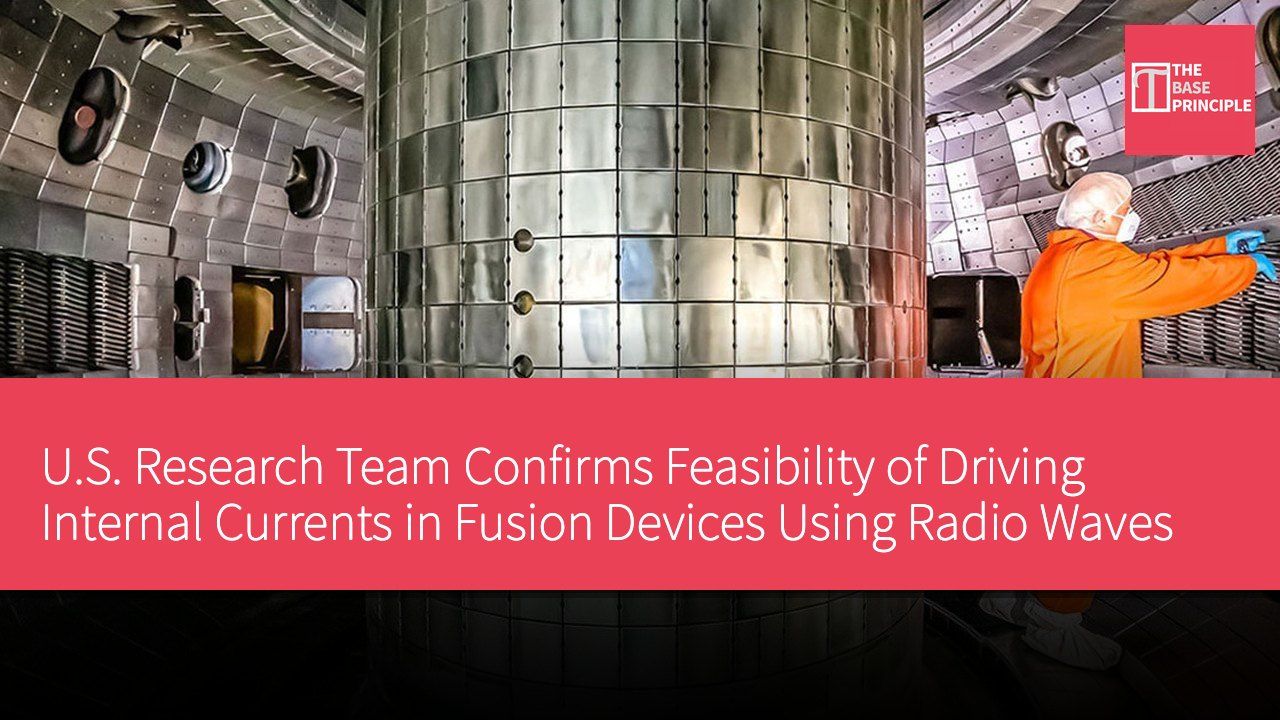
- DIII-D National Fusion Facility confirms the feasibility of helical current drive for the first time.
- The research team launched helical waves at 476 MHz to drive plasma currents.
- Tests showed electron pressure was lower than expected, with insufficient power absorption efficiency.
- Combining multiple current drive types may increase system complexity.
Researchers at the DIII-D National Fusion Facility in San Diego report that experimental evidence has confirmed the feasibility of helical current drive, a method that uses radio waves to propel plasma currents within a tokamak. The results were published in Physical Review Letters, with physicists Jeff Lestz, Bob Pinsker, and Bart Van Compernolle from General Atomics serving as lead authors. A tokamak is a toroidal device that confines plasma (a superheated, charged gas) in a specific location using magnetic fields.
Most tokamaks use a central coil called a solenoid to induce plasma currents, which must be reset, ending each pulse. Pinsker told Gizmodo that DIII-D's pulses last about 10 seconds. Lestz noted that commercial designs typically require steady-state operation. Researchers attempted this type of radio wave in the 1980s. The paper indicates that the currents they observed were due to accidental conversion to other waveforms, so helical current drive had never been confirmed.
Results of Radio Wave Driving Tests
The team emitted helical waves at 476 MHz from a 30-module antenna approximately 5 feet (1.5 meters) long. According to the paper, 370 kilowatts of power were injected during this current drive test, and the team compared three different emission scenarios: helical power, no additional power, and microwave heating of similar intensity. The plasma current can be altered solely by heat, allowing this comparison to isolate the two effects. When using helical power, the electron temperature near the center increased by about 1 keV, which corresponds to approximately 21 million degrees Fahrenheit (11.6 million degrees Celsius).
The safety factor, a measure of magnetic field distortion, dropped more quickly than in the case of heating with a single emission. The sawtooth phenomenon inside the core, which is a repetitive drop in temperature, began around 1500 to 1600 milliseconds, compared to 1900 to 2000 milliseconds without helical power, or did not occur at all. The authors calculated that the driving current near the center was 20 kA, with a margin of error of plus or minus 10, while simulations predicted a current of 21 kA in that region. The paper states that the plasma density was sufficient to exclude other waveforms.
Challenges and Future of Current Drive
The paper notes that the electron pressure in the test plasma was far below the expected reactor levels. In these plasmas, simulations predicted that only about 40% to 47% of the power would be absorbed on the first pass. At that time, only one side of the antenna was functioning, preventing the team from comparing currents driven in the opposite direction. The paper indicates that it is not yet possible to determine whether the 20 kA value reflects incomplete absorption or lower efficiency. Its claim that this method is applicable to reactors is a theoretical inference. Pinsker stated at the American Nuclear Society that it is too early to assert whether helical current drive will become the preferred option.
He pointed out that combining several types of current drive would increase complexity. Gizmodo reported that he believes enhancing helical power is the most direct way to improve results. The paper mentions that the KSTAR tokamak has also installed helical antennas and begun debugging. This work is funded by the U.S. Department of Energy's Office of Science, and the research findings were published in Physical Review Letters.
Potential and Challenges of Helical Current Drive
This research demonstrates the potential of using radio waves to drive internal currents in fusion devices, providing new insights for the development of fusion technology. Although the experimental results indicate the feasibility of helical current drive, practical applications still face challenges such as lower-than-expected electron pressure and insufficient power absorption efficiency. Future research needs to further optimize driving methods to enhance efficiency and overcome system complexity, which is crucial for the design of commercial fusion reactors.