
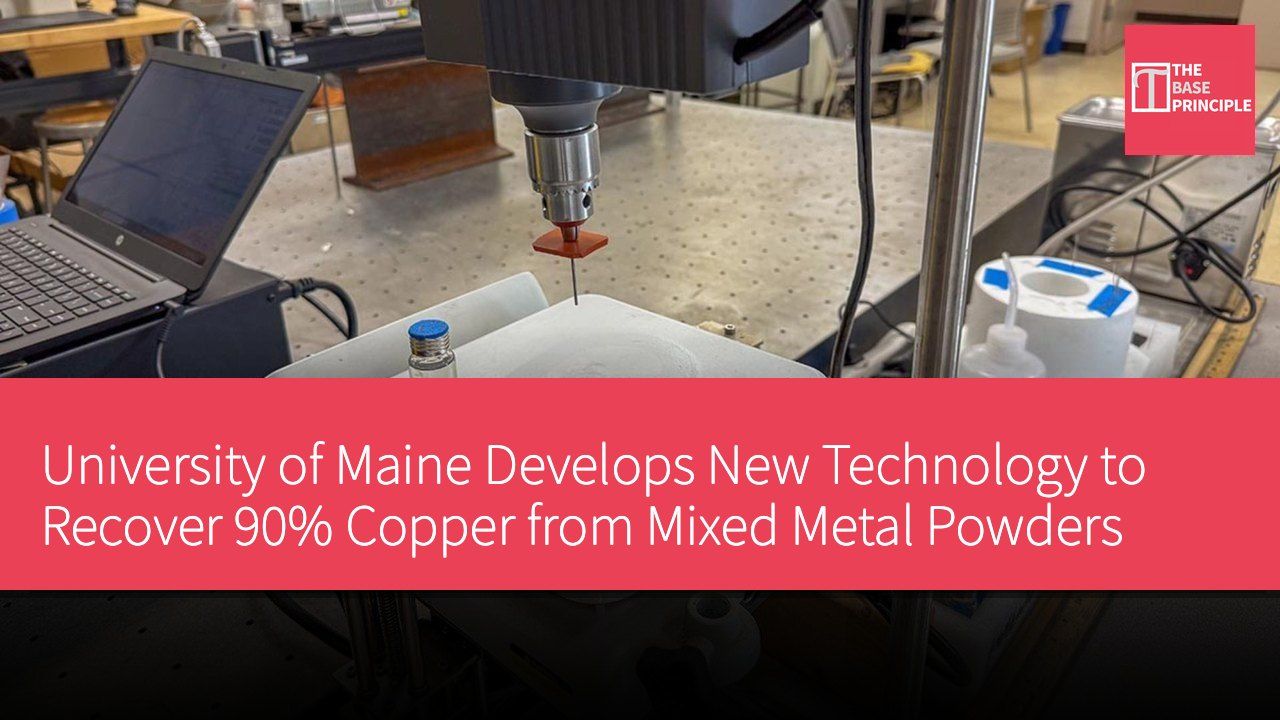
- The University of Maine has developed new technology to recover high-value metals, including copper and aluminum.
- The new process helps address supply chain uncertainties for critical minerals.
- Researchers use the SHAPE method to recover metals from powders and selectively capture particles.
- The future goal is to develop an AI-driven automated recycling system.
Researchers at the University of Maine have developed a new method aimed at recovering high-value metals, including copper and aluminum, from contaminated powder mixtures. This breakthrough has the potential to bolster the United States' "Made in America" goals. These high-value materials are often used in the manufacturing of precision-engineered components, such as biomedical implants, aircraft parts, battery materials, and cutting tools. Given that material loss is a significant challenge faced by various critical sectors, the researchers at the University of Maine have set out to address this issue. Chief researcher and associate professor of mechanical engineering Bashir Hoda stated, "We are trying to tackle the significant material loss occurring during the production processes of high-value components and products in critical areas such as aerospace, energy storage, tools, biomedical devices, and electronics."
He noted that this new process could make manufacturing more robust by helping to address supply chain uncertainties for critical minerals, which affect costs, availability, and production resilience.
Recycling Method of the New Technology
In this study, researchers focused on recovering metals from powder mixtures that are often discarded due to cross-contamination during processing. Using a method called Shear-assisted Particle Capture (SHAPE), the researchers mixed two critical metals in a liquid suspension. They placed the mixture in a rotating machine to separate individual particles at variable speeds. The team then captured isolated particles on a thin layer of polymer film. In experiments, the team tested aluminum and copper particles with diameters ranging from 0 to 25 micrometers. The team suspended the particle mixture in liquid and exposed it to rotational speeds ranging from 200 to 1,500 revolutions per minute (rpm).
At approximately 200 rpm, about 87% of the particles captured on the substrate were the lighter material aluminum. As the rotational speed increased to 1,500 rpm, the proportion of copper reached about 90%. Researchers indicated that by fine-tuning process parameters, they could selectively capture different particles.
Despite achieving high particle selectivity in laboratory demonstrations, the yield of recovered material from the starting materials remains very low. Hoda stated, "The current research demonstrates the selectivity of this mechanism, rather than an industrial-ready recycling process. The next challenge is to maintain this selectivity while significantly increasing the volume of material that can be processed and recovered." Future work will examine the size and geometry of substrates, the use of multiple substrates, particle loading, polymer concentration, processing time, and continuous or multi-stage operations to increase the amount of material processed while maintaining selective separation. The team also plans to evaluate whether the recovered powders possess the necessary characteristics for reuse by examining their chemical composition, morphology, flowability, and manufacturing performance.
Future Automation Goals
In the long term, the researchers aim to achieve an automated process by integrating it with artificial intelligence. Hoda stated, "Our long-term goal is not just to separate particles in the lab but to develop a scalable, AI-driven manufacturing system capable of recycling cross-contaminated powders and returning usable materials to the additive manufacturing supply chain and other sectors." Related research findings have been published in the journal Powder Technology.
Item Specification Processor/SoC Not provided RAM Not provided Storage Not provided Battery Capacity Not provided Screen Size/Resolution Not provided Camera Pixels/Aperture Not provided Fast Charging Watts Not provided Connectivity Not provided Weight/Dimensions Not provided Refresh Rate Not provided
Impact of the New Technology on Manufacturing
The development of this new technology not only aids in the recovery of high-value metals but may also strengthen the resilience of the U.S. manufacturing sector by addressing supply chain uncertainties. As material loss becomes a challenge in many critical areas, this innovative approach can enhance resource efficiency and reduce reliance on new materials. Further automation and AI integration will enable this technology to possess industrial application potential, promoting sustainable manufacturing and positively impacting both the environment and the economy.