
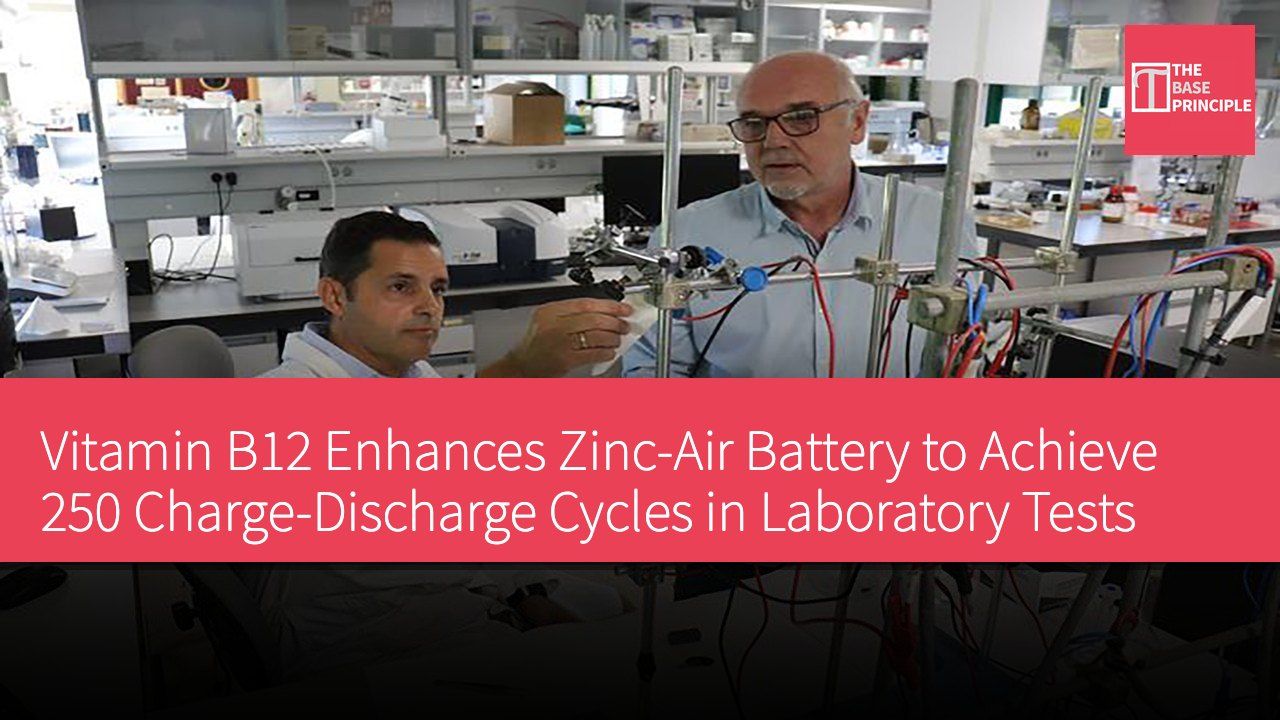
- The zinc-air battery uses Vitamin B12 as a catalyst, completing 250 charge-discharge cycles.
- Vitamin B12 is water-soluble and needs to be anchored to single-walled carbon nanotubes to enhance stability.
- The research team is seeking natural materials to design new types of batteries and is exploring challenges in the charging process.
- This research offers new directions for the sustainability of renewable power storage.
Researchers at the University of Córdoba have developed a zinc-air battery that uses Vitamin B12 as a catalyst, completing up to 250 charge-discharge cycles in laboratory tests. According to a statement from the university and a paper published in the journal Materials Chemistry A, the zinc-air battery extracts oxygen from the surrounding air rather than storing it internally, making it lighter. The water-based electrolyte of the battery is non-flammable, and this type of battery has already been used in small devices such as hearing aids.
Charging is relatively challenging because the catalyst needs to function during both the discharge and charging processes. Vitamin B12, also known as cobalamin, contains trivalent cobalt, a form of cobalt. It is easily soluble in water, which means it can be washed away in water-based electrolyte batteries. The research team anchored it to single-walled carbon nanotubes, which are extremely thin carbon tubes.
The Catalytic Role of Vitamin B12
The prototype comes from the Physical Chemistry Research Group at the university's Institute of Chemical Energy and Environment. The paper describes how Vitamin B12 was chemically bonded to the nanotubes without high-temperature treatment. Antonio Jesús Fernández Romero, a researcher on the team, stated that the vitamin "has proven to meet the conditions required to serve as a good catalyst." During the discharge process, it helps convert oxygen into water, while during the charging process, it facilitates the generation of oxygen.
Challenges in Designing New Batteries
Research author Manuel Cano Luna indicated that the team is seeking natural materials to design new types of batteries. The group has previously used biomolecules as catalysts twice: hemoglobin containing divalent iron and horseradish peroxidase containing trivalent iron. Charging is a new element in this research. Other laboratories are also pursuing the same bottleneck; researchers at the Chinese Academy of Sciences have developed a graphene catalyst that improves the round-trip efficiency of zinc-air batteries to about 98%. Darmstadt University of Technology reported a spinel catalyst that allows rechargeable batteries to operate for over 300 hours.
Regarding the results of the cycling tests, the data for 250 cycles comes from small laboratory batteries and does not imply that the batteries consistently maintain their initial performance. The paper's conclusion mentions more than 250 cycles, but its results are only reported up to 235 cycles. According to an analysis by the science news site XenoSpectrum, these batteries cycled with short steps of about six minutes for charging and six minutes for discharging. In a gel electrolyte battery, the discharge voltage at 180 cycles was at least 1 volt, while at 235 cycles, it was at least 0.9 volts.
The site also reported that the voltage required for the charging reaction alone, when using Vitamin B12, is 0.77 volts, compared to 0.45 volts for commercial cobalt oxides.
The university noted that this result paves the way for cheaper and more sustainable renewable power storage. XenoSpectrum pointed out that the durability under deeper charge-discharge processes still needs to be examined. To date, no independent replication of the experiments has been reported. The release did not provide a timeline for further work.
Item Specification Charge-Discharge Cycles 250 cycles Discharge Voltage (180 cycles) At least 1 volt Discharge Voltage (235 cycles) At least 0.9 volts Charging Voltage (Vitamin B12) 0.77 volts Charging Voltage (Commercial Cobalt Oxide) 0.45 volts
The Potential of Vitamin B12 in Zinc-Air Batteries
The development of zinc-air batteries represents a significant advancement in renewable energy storage technology. Using Vitamin B12 as a catalyst not only enhances battery performance but also reduces costs and environmental impact. This research demonstrates the potential application of natural materials in battery technology, particularly in addressing challenges faced during the charging process. While current cycling tests show promising performance, further independent validation and long-term durability testing are needed to ensure reliability in commercial applications.