
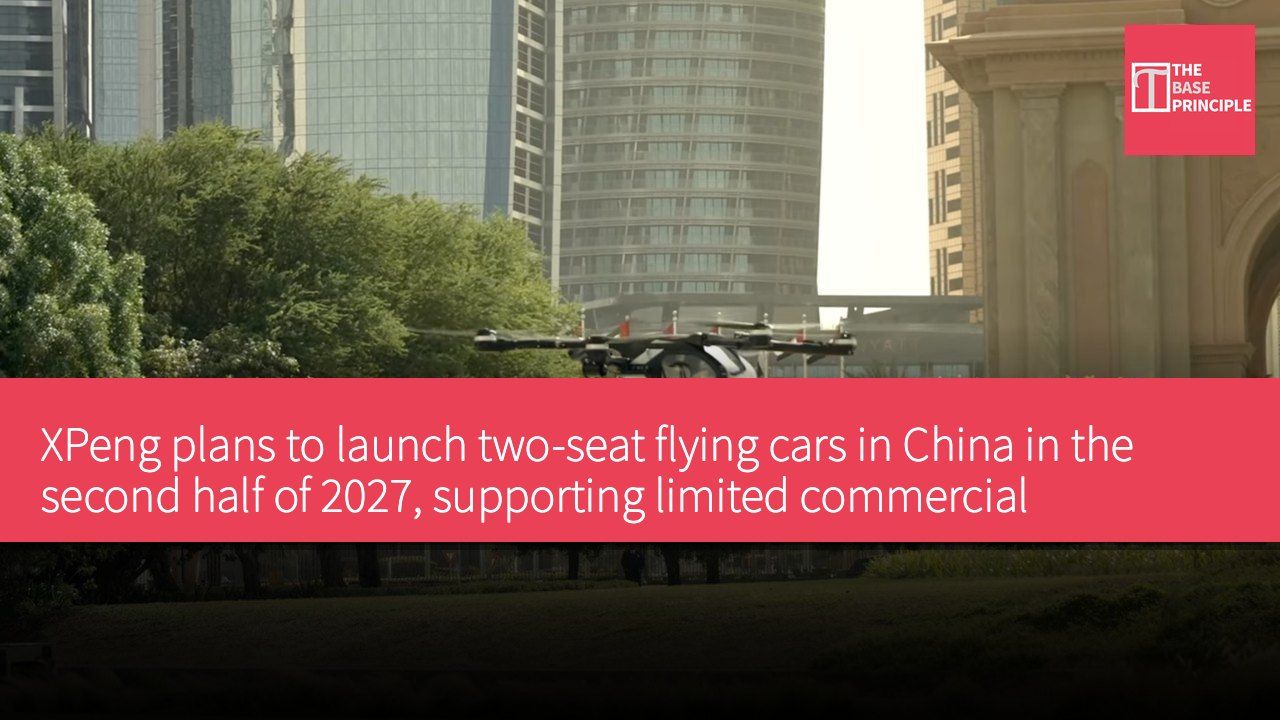
- XPeng plans to launch two-seat flying cars in the second half of 2027, supporting limited commercial operations.
- The aircraft has received approval from the Chinese civil aviation authorities and has undergone ten years of development.
- XPeng's aircraft will primarily be used for recreational and emergency services, targeting specific activity users in the initial market.
- XPeng has established a large manufacturing facility in Guangzhou, aiming for an annual production of 10,000 aircraft modules.
Electric vehicle manufacturer XPeng has reportedly announced that its two-seat flying cars are expected to begin limited commercial operations in China in the second half of 2027. The company plans to offer this low-altitude aircraft for recreational use and emergency services in rural areas. This aircraft, which has undergone extensive testing, has been in development for ten years, including trials of flying motorcycles at XPeng's facility in Guangzhou. XPeng unveiled the flying car at the 2025 Consumer Electronics Show (CES), featuring a modular design that includes a detachable aerial module housed within a ground vehicle.
Commercial Operation Plans for the Flying Cars
XPeng plans to launch its two-seat flying vehicles in the second half of 2027, with a price set at approximately US$300,000 (about HK$2,340,000). The aircraft has received approval from the Chinese civil aviation authorities for limited operations after nearly a decade of development and testing. XPeng CEO He Xiaopeng stated that the initial market will include recreational users interested in activities such as diving, surfing, and off-roading. However, the aircraft will initially be restricted to approved park areas in China and will be used for emergency services in hard-to-reach locations, according to The Guardian.
The reported range of the aircraft is 18.6 miles (30 kilometers), capable of cruising at a maximum altitude of 0.6 miles (1 kilometer). According to He Xiaopeng, XPeng plans to double its range by increasing battery energy density to 400 kilowatt-hours per kilogram. This development is part of a broader push in China to establish a low-altitude economy, encompassing drones, cargo aircraft, and passenger flying vehicles. He Xiaopeng noted that XPeng is one of about 20 Chinese companies developing flying vehicles and has signed agreements with the UAE and Southeast Asian countries to explore potential applications.
Last month, Elon Musk revealed an experimental Tesla Roadster prototype equipped with rocket-inspired propulsion and anti-gravity stunts. During a demonstration at SpaceX's facility in Texas, the vehicle executed aerial flips, jumps, and controlled landings using compressed air nozzles.
XPeng's Manufacturing Facilities and Production Capacity
Notably, XPeng has also launched its Land Aircraft Carrier, AEROHT, a modular transportation system that combines a drivable electric vehicle with a detachable electric vertical takeoff and landing (eVTOL) aircraft. Users can drive to a suitable location, deploy the aircraft, and take off without the need for a traditional airport. AEROHT was renamed ARIDGE in October 2025 and is XPeng's flying mobility subsidiary. The ground vehicle, referred to as the mothership, features a three-axis six-wheel configuration with all-wheel drive and rear-wheel steering.
Measuring approximately 5.5 meters (18 feet) in length, 2 meters (6.6 feet) in width, and 2 meters (6.6 feet) in height, it is designed to fit standard parking spaces. Its rear section accommodates the aircraft and includes an automatic deployment mechanism, also serving as a mobile charging station.
The extended electric power system utilizes an 800-volt silicon carbide platform and offers a claimed combined driving range of over 621 miles (1,000 kilometers) under China's CLTC testing cycle. The detachable aircraft is a two-seat electric vehicle with six rotors arranged in a dual-duct configuration. Its rotor arms and propeller blades can fold inward for easy accommodation within the mothership. The aircraft is made from carbon fiber materials and features a 270-degree panoramic cockpit, supporting both manual and autonomous flight modes, with a single-stick control system for manual operation. Autonomous features include one-button takeoff, route planning, flight control, and landing assistance.
Redundant safety systems cover propulsion, flight control, power, and communication. The automatic mechanism allows the aircraft to separate from the mothership in about five minutes and reconnect after landing. The ground vehicle can charge the aircraft while driving or stationary.
XPeng has established a 1.29 million square foot (approximately 120,000 square meters) manufacturing facility in Guangzhou, with trial production set to begin in November 2025. The factory is designed for an annual production capacity of 10,000 aircraft modules, with an initial production target of 5,000 units. Customer deliveries, originally scheduled for 2026, are now planned to start next year.
Item Specification Range 18.6 miles (30 kilometers) Altitude Cruise 0.6 miles (1 kilometer) Battery Energy Density 400 kilowatt-hours per kilogram Length 5.5 meters (18 feet) Width 2 meters (6.6 feet) Height 2 meters (6.6 feet) Annual Production Capacity 10,000 units
Market Potential and Challenges for XPeng's Flying Cars
XPeng's flying car initiative marks a further development in China's low-altitude economy. With the rise of drones and passenger flying vehicles, demand for such new transportation tools may increase. However, the commercialization of flying cars faces numerous challenges, including technological maturity, regulatory compliance, and market acceptance. Additionally, the high price of the product may limit its initial market expansion. XPeng's success will depend on its ability to effectively address these challenges and secure a foothold in a competitive market.