
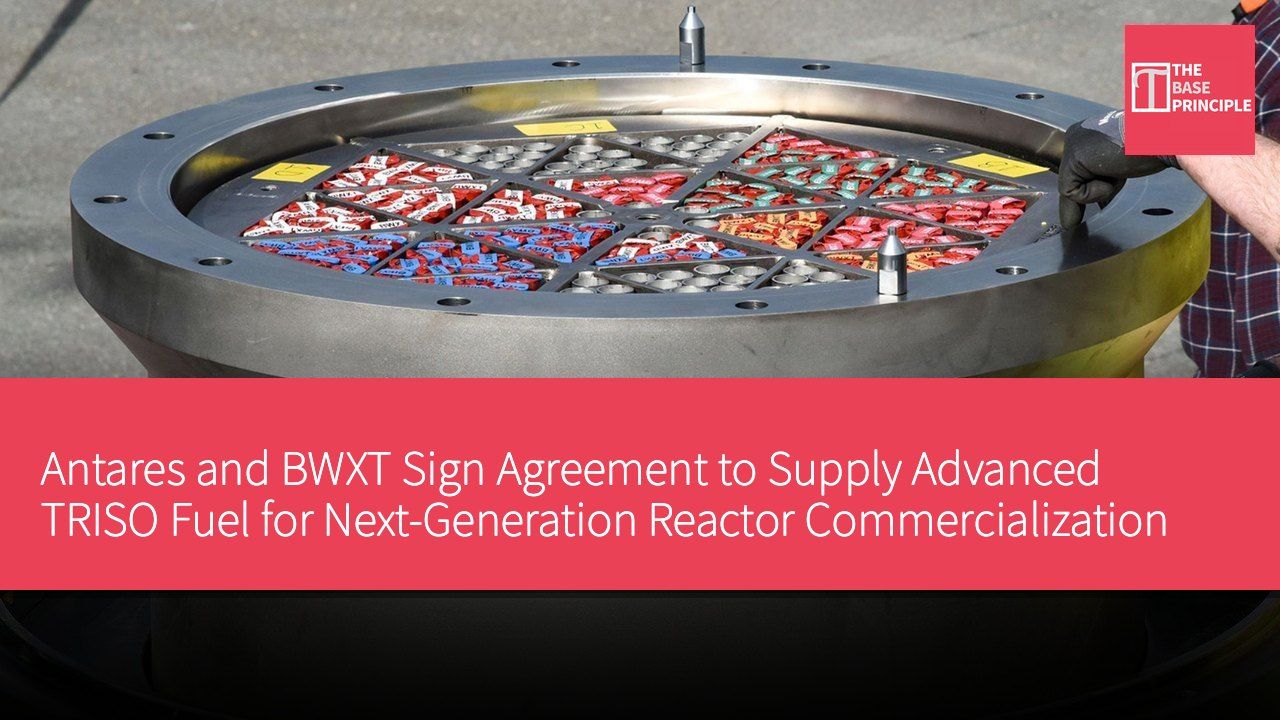
- Antares has signed an agreement with BWXT for the supply of advanced TRISO fuel.
- BWXT's fuel production facility is located in Virginia and is well-established.
- Antares plans to use this fuel in the Mark-1 reactor, expected to be operational by 2027.
- The commercial pilot project in New Brunswick will utilize BWXT's micro-reactor design.
Nuclear developer Antares has signed a multi-year agreement to purchase advanced fuel from BWXT. This agreement marks a significant step in the commercialization of next-generation reactors. According to the contract announced today, BWXT advanced fuel will be produced at its facility in Lynchburg, Virginia, using TRISO (tristructural-isotropic) fuel. The agreement initially covers one metric ton of uranium, with options for expansion as demand grows. Deliveries will be made according to future mission directives, with specific delivery dates and specifications set.
The Virginia production line is already quite mature, having previously supplied fuel for the U.S. government's Project Pele and the Antares Mark-0 test reactor. The demonstration unit successfully achieved sustained fission earlier this year, using BWXT's fuel. Currently, both companies aim to translate this technology into commercial output. Joe Miller, President of BWXT's Government Business, stated, "BWXT's decades of experience in advanced fuel manufacturing provides a foundation of support for Antares, helping them accelerate commercial deployment."
He noted that the company has improved the fuel manufacturing process.
Antares' Reactor Plans
Antares plans to use this fuel in its first power generation system, the Mark-1 reactor, which is expected to be operational by 2027. Ensuring a stable production line over the next decade provides reliability for early commercial operations. Jordan Bramble, CEO and co-founder of Antares, stated, "We have achieved criticality with BWXT fuel, which will power our Mark-1 power reactor." He added, "Ensuring continued use of this production line before the decade ends means our initial deployment will use fuel from a team and process we have already validated."
New Brunswick Pilot Project
In North America, as reactor technology accelerates, Antares' collaboration with BWXT comes at a time when it is also advancing its own reactor technology. Earlier this month, the developer selected the company's micro-reactor design for a commercial pilot project located in Belledune, New Brunswick. This Canadian project features a unique ownership model led by Prodigy Clean Energy, in direct collaboration with the Pabineau and Eel River Bar Indigenous communities.
The facility will be located on traditional Indigenous land and will be owned by Indigenous peoples, expected to provide clean power to the local grid in the early 2030s.
The Belledune site will house two BWXT Advanced Nuclear Reactor (BANR) units. Each unit can generate up to 50 megawatts of electricity. Additionally, each unit can produce 22 megawatts of electricity and 75 megawatts of thermal energy. Notably, both the Antares reactor and BANR units rely on TRISO particles. These small fuel cores encapsulate high-density low-enriched uranium and feature a robust ceramic outer layer. These layers act as miniature pressure vessels, capable of containing radioactive fission products even at high temperatures.
The BANR system also avoids traditional active cooling pumps, relying instead on passive cooling. Therefore, even in the event of a power outage, natural air convection and radiative heat transfer can automatically cool the reactor without mechanical intervention. "As demand grows in the advanced reactor space, BWXT is ready to scale," Miller concluded.
Commercial Significance of TRISO Fuel
The collaboration between Antares and BWXT marks an important step in the commercialization of advanced nuclear technology. The use of TRISO fuel not only enhances reactor safety but also improves energy efficiency, which is crucial for addressing the growing energy demand. Furthermore, the success of this collaboration will promote the development of the North American nuclear market, particularly in the context of the clean energy transition, providing strong support for future nuclear projects.