
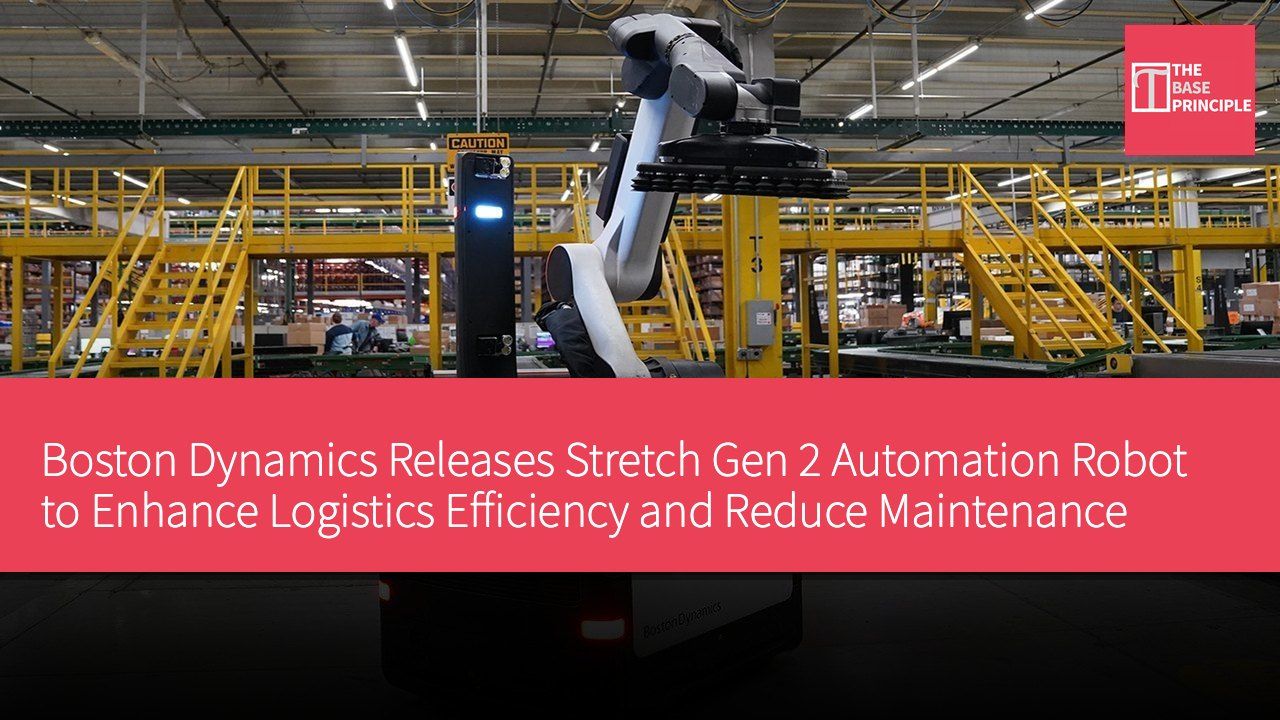
- Stretch Gen 2 is designed to speed up unloading and reduce maintenance downtime.
- The new robot features a redesigned gripper and improved sensors.
- Maintenance time is significantly reduced, with a complete steering drive replacement taking only about one hour.
- The internal computing platform supports ongoing software improvements to enhance machine performance.
Hyundai-backed Boston Dynamics has announced Stretch Gen 2, a next-generation automation robot aimed at speeding up unloading and reducing maintenance downtime in high-capacity logistics operations. This upgraded robot is based on over 100,000 hours of operational data and the unloading experience of millions of boxes, featuring a redesigned gripper, improved sensors, an 81% reduction in internal wiring, and modular components for faster repairs. These changes are intended to prevent mechanical wear and electrical failures, thereby avoiding robot downtime.
Boston Dynamics has also redesigned the exterior panels to withstand falling boxes and repositioned the emergency stop button to minimize accidental safety shutdowns.
Brian Donnelly, Vice President and General Manager of Logistics Robots at Boston Dynamics, stated, "Our customers rely on Stretch to keep goods moving, and every hour the robot is idle means work piling up at the dock." He added, "In Gen 2, we focused on the factors that lead to robot downtime in real-world operations. We made it more robust, simplified maintenance, and ensured it continues to improve after deployment."
Significant Reduction in Maintenance Time
This redesigned robot also aims to reduce the time required for maintenance. When components need to be replaced, Boston Dynamics states that a complete steering drive replacement now takes about one hour, compared to a full day previously. The company has removed dynamic cables and complex wiring harnesses, replacing them with a simpler architecture and standardized high-strength fasteners. These changes are intended to reduce the number of tools needed during the repair process and shorten the time technicians spend working on the machine.
Stretch Gen 2 also includes on-site diagnostic and maintenance tools, allowing customers' maintenance teams to handle more routine upkeep tasks. This will reduce reliance on external support, helping the machines operate continuously in busy warehouse docks.
Ongoing Software Updates Enhance Performance
Apart from mechanical changes, Stretch Gen 2 operates on a redesigned internal computing platform that supports ongoing software improvements. Boston Dynamics states that regular software updates will enhance box detection, motion planning, picking strategies, and world modeling for deployed robot fleets. These updates can improve performance without requiring customers to replace or upgrade the physical hardware of the robots. The robot can unload up to 1,000 boxes per hour, with actual output depending on the weight of the boxes and how neatly they are stacked in the trailer.
The multi-picking capability allows it to handle multiple boxes in a single picking cycle, achieving higher throughput. Its battery design supports two shifts, and a fast charger can restore 90% of the charge in about 75 minutes. An integrated lighting system also enables the machine to operate in dimly lit trailers. Stretch is equipped with a pre-trained vision system that can recognize most packages from the first day of deployment without additional programming. Boston Dynamics positions Stretch as a solution for physically demanding tasks in automated logistics.
Unloading trailers involves handling a large number of packages in tight spaces, often under varying lighting conditions, and with different stacking methods.
The second-generation model builds on the company's existing deployments, with a stronger focus on reliability, maintainability, and sustained performance in demanding warehouse environments.
Future Trends in Automated Logistics
The launch of Stretch Gen 2 highlights the importance of automation technology in the logistics industry, particularly in enhancing efficiency and reducing maintenance needs. As market demand for fast and efficient logistics solutions increases, the design of this robot addresses challenges in real-world operations and lowers operational costs through simplified maintenance. The ongoing software update capability also underscores the flexibility of automated systems, allowing them to continuously optimize performance as demand changes, which is crucial for future logistics operations.