
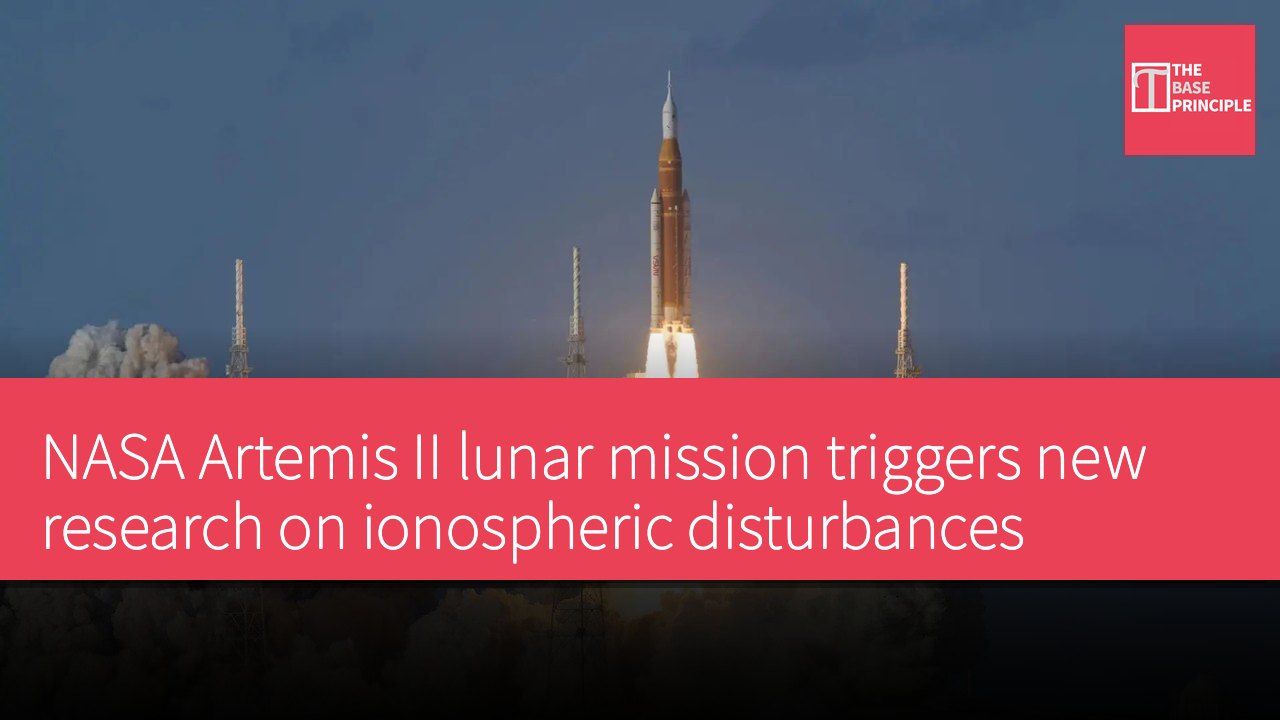
- NASA's Artemis II mission produced three disturbance events in the ionosphere.
- The disturbances are associated with spacecraft orbital maneuvers, indicating the impact of rocket exhaust on the atmosphere.
- Signals extended over 621 miles and exhibited unusual patterns during different maneuvers.
- The study shows that energy release directly affects the ionosphere, altering disturbance patterns.
A new study indicates that NASA's Artemis II lunar mission caused three distinct disturbance events in Earth's ionosphere, including two anomalies related to spacecraft orbital maneuvers. Researchers analyzed satellite navigation signals collected in North America and found changes in the ionosphere following the mission's launch and two subsequent engine firings. These findings suggest that rocket exhaust released during high-altitude maneuvers can impact the charged regions of the upper atmosphere on Earth.
Artemis II Mission Disturbance Events
The scientific background of the ionospheric disturbances associated with Artemis II first emerged on April 1, 2026, when the Space Launch System (SLS) rocket lifted off from Kennedy Space Center. Researchers identified shock waves propagating at approximately 0.7 miles per second (about 1.2 kilometers) near the launch site. Further from the launch point, these disturbances developed into gravity waves, which propagated at speeds of approximately 1,969 to 2,198 feet per second (about 600 to 670 meters), with a wavelength of about 249 miles (approximately 400 kilometers).
Signals appeared about 20 minutes after liftoff, extending over 621 miles (about 1,000 kilometers) from the launch area, and exhibited even more unusual patterns during the apogee raise maneuver (ARM), which occurred approximately 108 minutes post-launch. This maneuver involved an interim cryogenic propulsion stage (ICPS) engine firing lasting about 18 minutes, helping to place the Orion spacecraft into a higher orbit.
Characteristics of Ionospheric Disturbances
During this engine firing, researchers detected extended ionospheric disturbances covering a broad area of North America. The observed patterns followed the spacecraft's predicted trajectory, covering longitudes from approximately 110°W to 60°W. Their propagation speed was about 5.1 miles per second (approximately 8.2 kilometers), close to the estimated speed of Orion at about 5.2 miles per second (approximately 8.3 kilometers). The third event occurred during the translunar injection (TLI) engine firing on April 2, 2026, approximately 25 hours after liftoff. This maneuver utilized Orion's engines to send the spacecraft toward the Moon, lasting about five minutes and 55 seconds.
Researchers again identified extended disturbances, although this time the intensity was weaker than that observed during the previous orbital firings. The area of signal extension was smaller, located between longitudes 100°W and 80°W. Their estimated propagation speed was about 6.4 miles per second (approximately 10.3 kilometers), similar to the spacecraft's speed of about 6.5 miles per second (approximately 10.5 kilometers).
To further investigate the events, the research team examined global navigation satellite system (GNSS) signals from GPS, GLONASS, and Galileo satellites. The dataset included observations from over 3,500 ground stations across the Americas. These signals helped researchers measure changes in total electron content (TEC), an indicator of the number of electrons along the path between satellites and ground receivers. Changes in TEC can reveal disturbances in the ionosphere, the region of the upper atmosphere containing charged particles. The study further established that both orbital maneuvers began near the point where the spacecraft was closest to Earth, at an altitude of about 185 kilometers, placing the engine firings within the ionosphere.
Researchers estimated that the ICPS maneuver involved approximately 2.7 × 10¹¹ joules of energy, while the Orion TLI firing involved about 1.5 × 10¹⁰ joules of energy.
The correlation between the disturbance patterns and the spacecraft trajectory, along with their similar propagation speeds, indicates that the engine firings and their exhaust played a significant role in generating unusual signals. Researchers believe that the energy released directly within the ionosphere resulted in disturbance patterns different from those typically observed during the initial launch of a rocket.
Significance of Studying Rocket Exhaust Effects on the Ionosphere
The research from NASA's Artemis II mission reveals the impact of rocket launches and orbital maneuvers on the ionosphere, which is significant for future space missions. As space activities increase, understanding how rocket exhaust alters the characteristics of the ionosphere can help improve the reliability of satellite navigation and communication systems. This study not only enhances our understanding of Earth's atmosphere but also provides valuable data to support the design and execution of space missions, ensuring the safety and effectiveness of future endeavors.