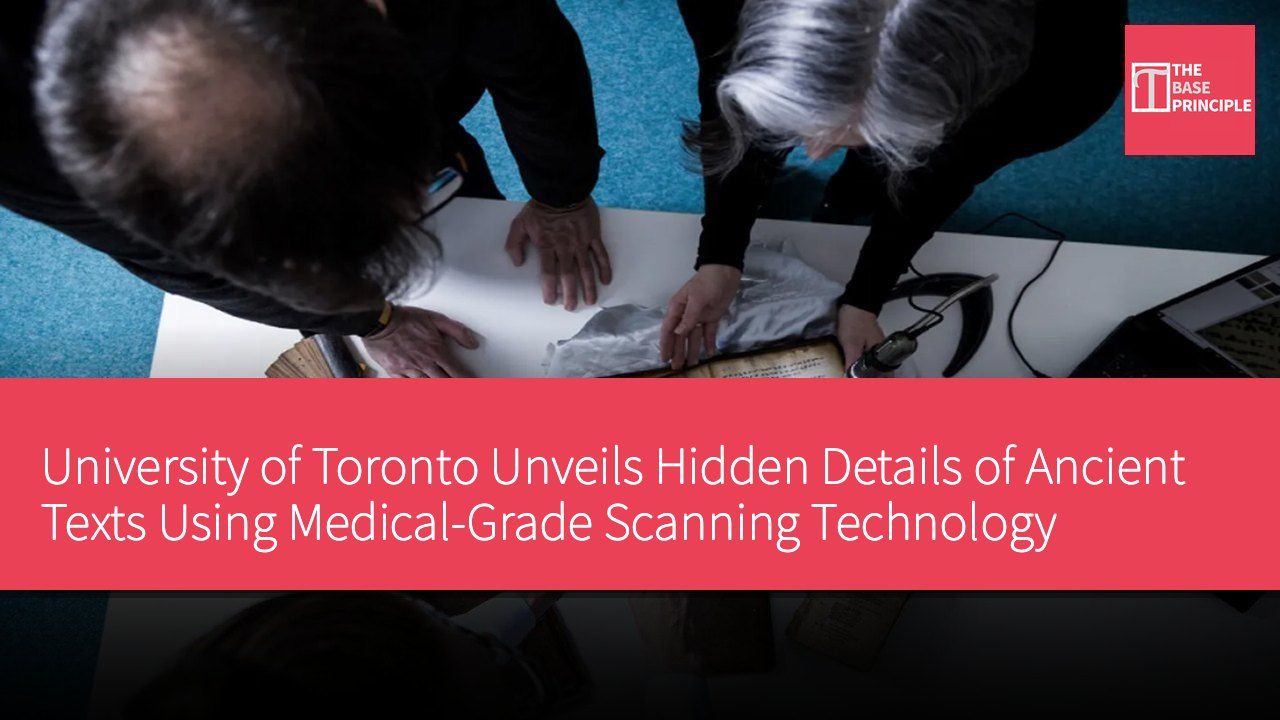
- The University of Toronto reveals details of ancient texts using medical-grade scanning technology.
- Micro CT scanning can create three-dimensional internal images that display hidden content.
- Researchers discovered hidden inks and images using the MISHA scanner.
- The lab's Hidden Stories project studies the physical and biological components of manuscripts.
Revealing Hidden Details of Ancient Texts
The second tool, a scanner named MISHA, can capture images of objects under 16 wavelength bands (or slices of the spectrum), including ultraviolet light. Subsequently, software allows researchers to scroll through the images to discover inks and images that are invisible under normal light. Scanning results show that a micro CT scan conducted by University of Toronto researchers in 2019 on a Book of Hours (a type of prayer book) revealed four original binding holes on its spine, according to the university's exhibition page. Reporter David Silverberg struggled to handle a clay tablet described as mouse-sized and Babylonian. Lockhart stated that the team created a three-dimensional image using micro CT scanning, magnifying its text for researchers to attempt translation. So far, the reading results indicate that it is a sales contract between two parties, according to CBC Arts.
Additionally, CBC mentioned the Andrews Book Science Project, which collaborates with the Thomas Fisher Library and the university's Yip Lab to scan a soldier's last letter from World War I, which contains a hidden pressed flower. In the past, the campus team using MISHA imaging helped identify the flower in Harold Rone's last letter as a bluebell. Rachel de Kress, a rare book librarian at the Thomas Fisher Rare Book Library, stated that researchers have "many different tools available" here.
Research of the Hidden Stories Project
The lab's Hidden Stories project is listed on its website as running from 2022 to 2026, in collaboration with the Institute for Advanced Study at Princeton and university libraries. CBC noted that the project studies the physical and biological components of manuscripts to understand the figures behind them. Multispectral imaging technology has also revealed hidden texts elsewhere. Researchers at the Zayed National Museum in Abu Dhabi used this technology to read verses hidden beneath gold leaf on pages of the Blue Quran. When a reporter observed MISHA scanning a 14th-century Chinese banknote, its layers revealed two square images that researchers are still attempting to decipher, according to CBC.
CBC's report is based on a feature article from a lab visit and interviews, and does not cite any published research or external experts; the reading results of the tablet remain in preliminary stages. Next, the lab will study documents discovered in Ukraine during World War II, which were buried in a milk can at the Poland-Ukraine border and are currently preserved by the university, according to CBC.Impact of Scanning Technology on the Study of Ancient Texts
The scanning technology at the University of Toronto not only reveals hidden details in ancient texts but also facilitates in-depth research of historical documents. Through micro CT and multispectral imaging technology, researchers can explore content that was previously unobservable, which is crucial for understanding the historical context and cultural value of ancient texts. Furthermore, the application of these technologies is not limited to ancient texts but can extend to the study of other artifacts, demonstrating their potential in artifact preservation and historical research.