
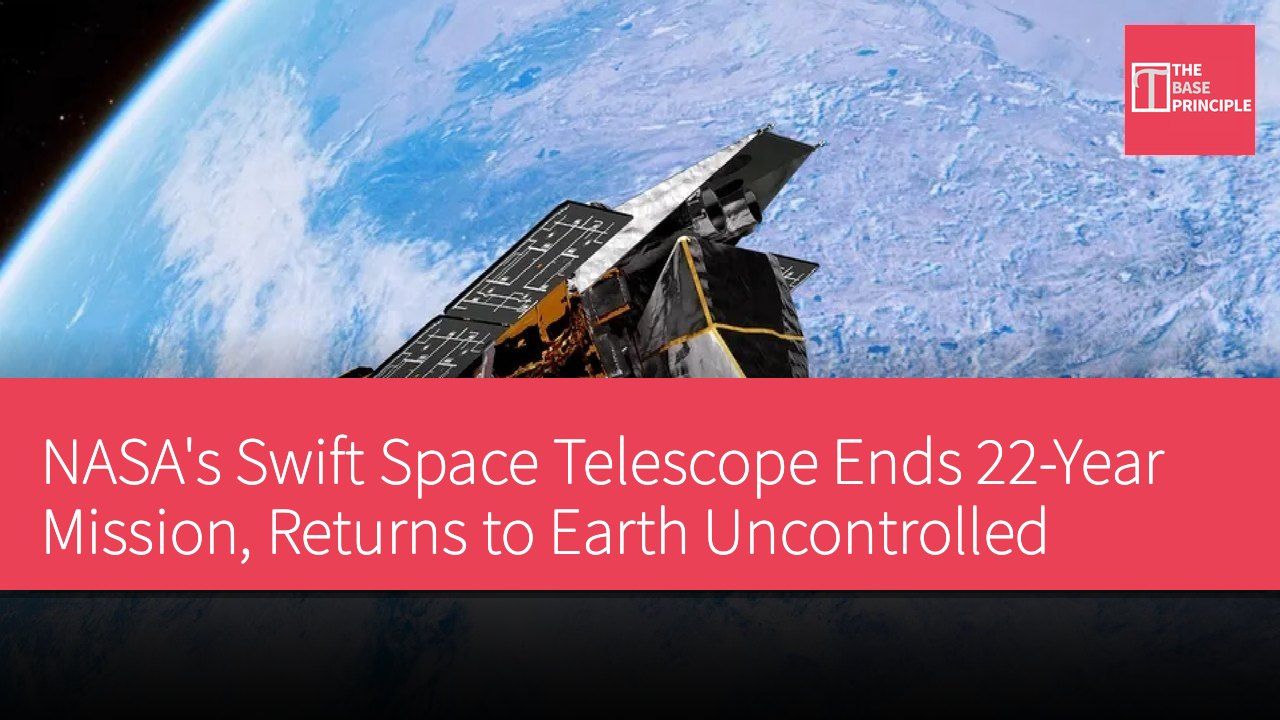
- The Swift Space Telescope returned to Earth uncontrollably on November 4, ending its 22-year mission.
- The telescope focused on studying gamma-ray bursts and conducted over 2,000 observations.
- NASA stated that Swift's productivity exceeded its original design by more than tenfold, providing lasting returns on investment.
- Such re-entry events are not uncommon, and this situation may increase as more space objects are launched.
The Swift Space Telescope returned to Earth uncontrollably on November 4, concluding its originally planned two-year mission after 22 years. The observatory re-entered the atmosphere just three months after a private rescue spacecraft was intended to boost it to a higher orbit to extend its lifespan. According to data from the U.S. Space Force cited by satellite tracker Jonathan McDowell, the 3,200-pound (1,450-kilogram) spacecraft re-entered the atmosphere at 7:39 AM EST (12:39 PM GMT) over northern Sumatra.
NASA predicted that most of the bus-sized observatory would burn up upon re-entry, with the chance of surviving debris causing harm to anyone on Earth estimated at 1 in 2,100. Videos appearing on social media seemed to show the fiery re-entry, although these clips have not been independently verified.
Scientific Contributions of Swift
Swift was launched in November 2004 with a mission originally planned for two years, focusing on the study of gamma-ray bursts, the most powerful explosions in the universe. Its name is not an acronym but a tribute to its agility. Swift had to detect and locate bursts, notify other observatories, and quickly adjust its instruments to capture images before the afterglow faded. This typically required about one minute, according to S. Bradley Cenko, the principal investigator at NASA's Goddard Space Flight Center. Additionally, Swift studied distant supernovae and observed black holes, asteroids, and comets within our solar system.
During its lifetime, Swift observed over 2,000 gamma-ray bursts and 1,400 supernovae. Its last scientific observation took place on October 20. In 2018, the telescope was renamed the Neil Gehrels Swift Observatory in honor of its first principal investigator, who passed away the previous year. NASA announced the mission's conclusion in a statement on October 23. Shawn Domagal-Goldman, director of NASA's Astrophysics Division, noted in the statement that Swift provided the nation with "incredible and lasting returns on investment," emphasizing that the mission was originally designed for two years,
but its productivity exceeded tenfold.
Swift had no onboard thrusters to counteract atmospheric drag that has been pulling it down since the day it was launched, causing its descent speed to accelerate as it gradually lowered. In September 2025, NASA awarded a $30 million contract to Katalyst Space in Arizona to build, launch, and operate a robotic spacecraft to boost it to a higher orbit. Katalyst launched its refrigerator-sized three-armed LINK servicing spacecraft on July 3, with plans to complete the capture in August.
Propulsion System Issues Led to Failure
Problems with the propulsion system and a failure of its reaction wheels, which maintain orientation, led to the mission's failure, with LINK itself returning to Earth on September 25. Nevertheless, NASA still considered the effort worthwhile. Domagal-Goldman described it as a "high-risk, high-reward mission" that advanced U.S. spacecraft servicing technology and tested how to operate satellites to extend their operational time in low Earth orbit.
The re-entry of Swift is not uncommon. A report from 2025 indicated that, on average, at least three large objects, such as defunct satellites or spent rocket stages, re-enter the Earth daily. This number may increase with the construction of more large constellations. According to early reports, Swift's data contributed to approximately 7,000 scientific papers, while increased solar activity accelerated its descent.
Impact of the Swift Telescope and Future Challenges
The conclusion of the Swift telescope marks the end of an important scientific era, as the mission played a critical role in the study of gamma-ray bursts and provided a wealth of data to the scientific community. Despite facing challenges with its propulsion system, NASA still deemed this high-risk mission worthwhile, as it advanced the development of satellite servicing technology. With the increasing number of space objects, future space missions will require more effective management and technology to address similar challenges, ensuring the continued progress of safety and scientific exploration.