
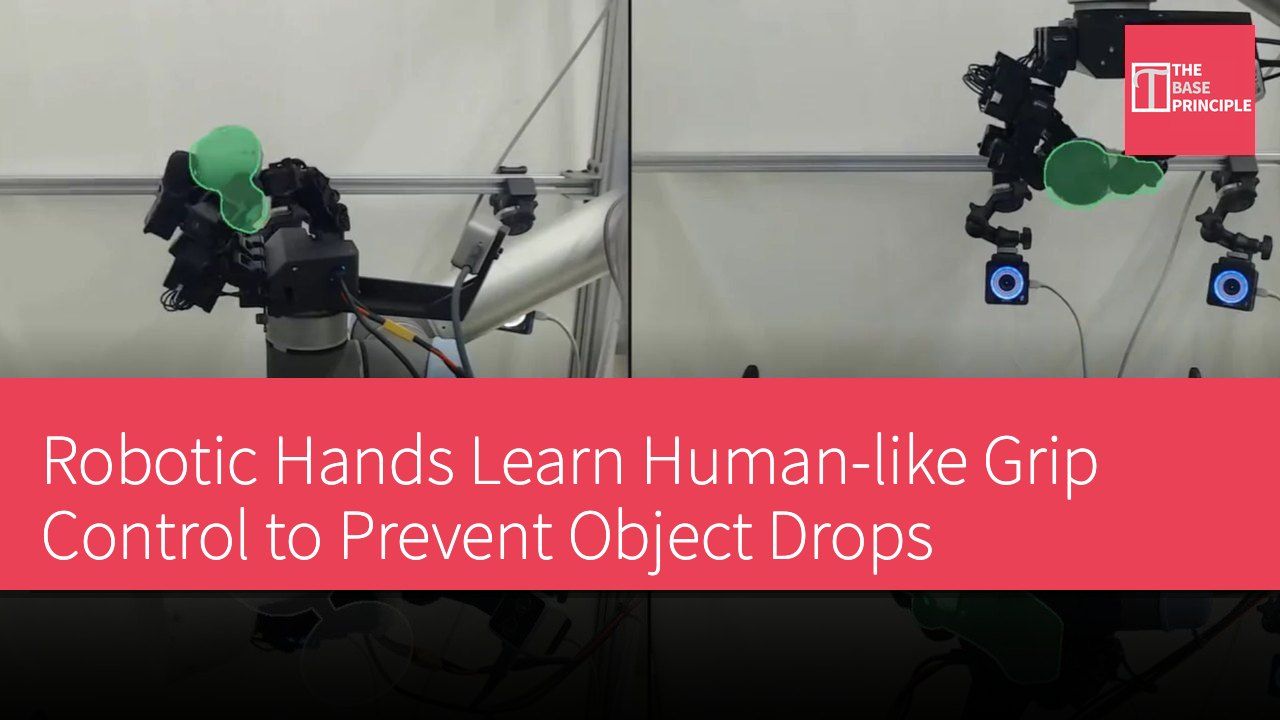
- Teaching robots grip control to prevent object drops is a technical challenge.
- Safety mechanisms can reduce object drops but impact robot accuracy.
- Researchers trained robot grasping behavior using simulation models.
- Future goals include improving safety system efficiency and creating multi-object controllers.
Teaching robots to grasp, rotate, and reposition objects to prevent drops remains a significant technical challenge. While humans instinctively adjust finger pressure, the risk of dropping objects is particularly high when the palm is facing down. Scientists have now made notable progress in addressing this issue. In addition to being able to rotate objects and place them in various positions in the hand, the robotic hand is equipped with a software-based safety system to prevent objects from slipping out of the fingers. This research was conducted by Ian Chuang and colleagues from the University of California, Berkeley, and the University of California, Davis.
Robot Grasping Training Method
The robot was trained through computer simulations. Although the safety mechanism reduced the number of dropped objects from 16 to 4, it also had a slight negative impact on the accuracy of certain targets during 1,200 tasks. However, the safety settings can be adjusted independently of task performance, allowing for a balance between the goal of safe grasping and successful object manipulation. Researchers used a LEAP robotic hand with 16 joints to complete the tasks, which were conducted solely through computer simulations without any human demonstrations.
To develop the simulation model, researchers analyzed the behavior of robot motors in the real world and incorporated this behavior into the simulation.
In the initial training phase, the computer generated millions of grasping scenarios. To facilitate grasping, the friction between the fingers and the objects was set higher than in real-world scenarios. As the robot's performance improved, the artificial friction was reduced to create more realistic conditions. The robot was then tested in the physical world using four 3D-printed plastic objects: a knife, a wine glass, a duck, and a light bulb. Each object was controlled separately. The safety mechanism was trained separately from the main controller. It can adjust the robot's movements to maintain a secure grip on the objects while minimizing interference with the primary task.
Testing Results of the Safety Mechanism
The safety mechanism does not receive information about the final target position and does not gain any rewards for reaching the target. To test the system, 4,800 experiments were conducted involving 4 objects and 6 wrist angles, with each test sequence containing 50 targets. External motion tracking cameras were used to measure the movement of objects in the robot's hand. Experiments were stopped and restarted when objects dropped or became stuck. Without the safety mechanism, the success rate was 95.2%, while with the safety mechanism, the success rate was 91.5%.
Success criteria included: within 2 centimeters of the target, within 23 degrees of the target, and within 10 seconds.
Researchers also demonstrated the process of the robot installing a light bulb, which included first rotating the bulb, then moving it to the socket, and finally tightening it to turn on the light. However, the safety mechanism was not always effective in each demonstration, indicating a trade-off between accuracy in reaching the target and maintaining a secure grip on the object. In the future, researchers hope to improve the efficiency of the safety system and create a single controller for multiple objects, which could ultimately lead to more dexterous robotic hands capable of manipulating delicate items. Their research findings have been published on the arXiv preprint server.
Trade-offs Between Safety Mechanisms and Operational Accuracy
The development of robotic grasping technology faces challenges between safety and operational accuracy. While the new safety mechanism significantly reduces object drops, it also impacts the robot's task accuracy. This trade-off is not uncommon in robotic technology, especially in applications requiring fine manipulation. Researchers aim not only to enhance the safety of grasping but also to design robotic hands that can flexibly handle various objects in the future, which will have significant implications for the practicality and application scope of robotic technology.