
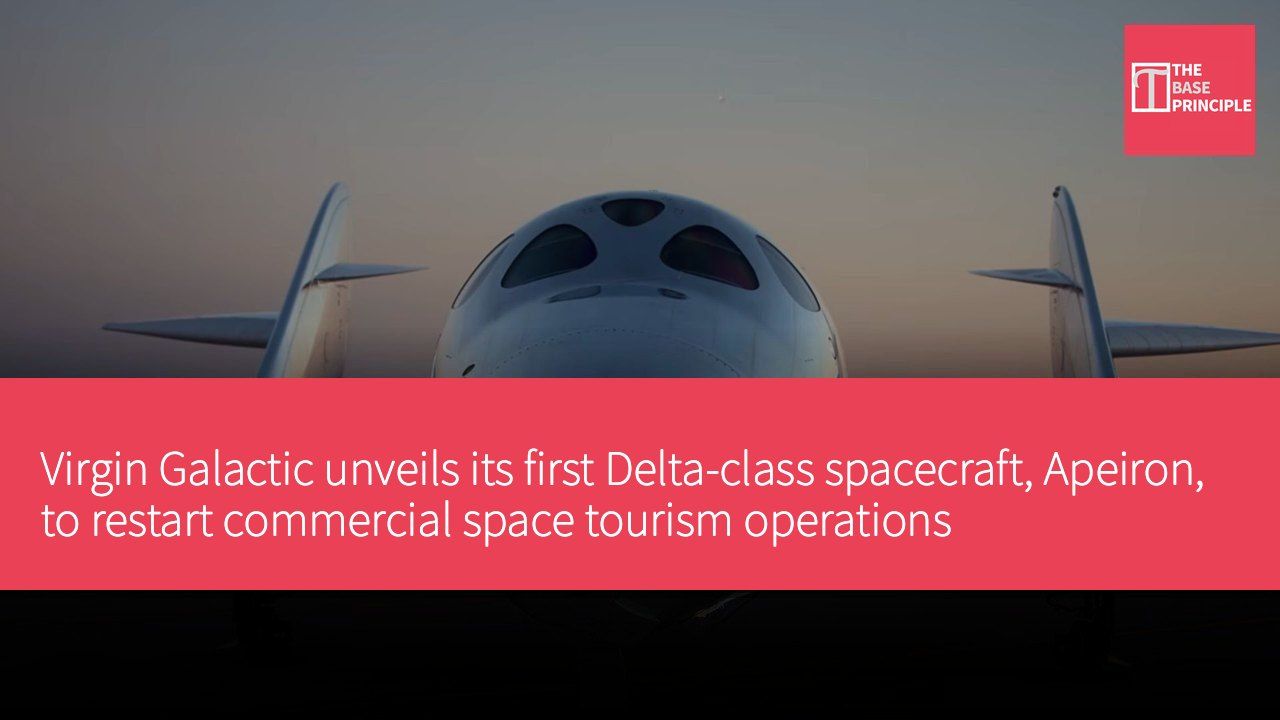
- Virgin Galactic's first Delta-class spacecraft is named Apeiron, meaning "infinite."
- Apeiron is designed to carry six passengers, increasing the number of paying seats.
- Each Delta-class spacecraft can support up to eight flights per month.
- Virgin Galactic plans to pursue scientific research and government missions, expanding its business scope.
Virgin Galactic has named its first Delta-class spacecraft Apeiron, a term derived from ancient Greek meaning "infinite." The spacecraft is designed to restart its commercial space tourism operations. This naming result came from a public vote that attracted thousands of responses from 83 countries across six continents. Apeiron is designed to carry six private passengers and is expected to enter commercial service in early Q2 2027 from Spaceport America in New Mexico.
It will replace VSS Unity, which completed its final commercial flight in June 2024. Virgin Galactic aims to establish a fleet capable of flying more frequently. CEO Michael Colglazier stated that the name reflects the ambition of human spaceflight and the possibilities it brings for exploring opportunities beyond familiar limits.
Design and Features of Apeiron
The cabin of Apeiron increases passenger capacity from Unity's four seats to six seats. This provides Virgin Galactic with two additional paying seats per flight, expanding capacity without the need for separate launches. The spacecraft will follow the company's established air-launch method, with its carrier Eve lifting it to approximately 50,000 feet before release. Apeiron will then ignite its rocket engine to ascend into suborbital space. Passengers will experience a brief period of weightlessness before the spacecraft glides back through the atmosphere and lands on a runway.
This journey remains suborbital, meaning Apeiron will return to Earth without completing an orbit around the planet. The core of this change lies in the aircraft used to provide the experience, along with the increased number of seats and a design that supports repeated operations.
Strategy for Increasing Flight Frequency
Virgin Galactic stated that each Delta-class spacecraft is designed to support up to eight flights per month. Achieving this goal would significantly increase the flight frequency realized by Unity. Meeting this target will depend on how quickly staff can inspect, maintain, and prepare each spacecraft. Delta vehicles are built using a modular approach, allowing teams to manufacture and maintain individual parts and systems separately. This method aims to streamline production and maintenance as Virgin Galactic expands its fleet. However, the anticipated flight rate remains a design goal that needs to be validated through testing, and commercial operations will also require verification.
For the company, increasing passenger numbers and shortening the intervals between flights are closely related goals that together help enhance the passenger count per spacecraft. The next phase for Apeiron will focus on preparations at Spaceport America, where the engineering team will check its avionics software before beginning flight tests. Virgin Galactic's revised timeline sets the start of commercial operations for early Q2 2027. The second Delta spacecraft is expected to follow in Q2 or Q3 of that year. This schedule reflects additional software work and validation.
These checks will help determine whether the spacecraft is ready to enter testing and ultimately serve passengers.
In addition to private astronaut flights, Virgin Galactic also plans to pursue scientific research and government missions. Further details on its operational plans are expected to be provided during the Q3 earnings call in November, as Apeiron transitions from the newly named spacecraft to its anticipated commercial role.
Virgin Galactic's New Direction in Commercial Space Tourism
The launch of Apeiron by Virgin Galactic aims to restart commercial space tourism, marking a significant step in the space tourism market. With an increase in passenger numbers and flight frequency, Virgin Galactic hopes to attract more consumers and lay the groundwork for future space exploration. Additionally, the company plans to further expand its business, including scientific research and government missions, which will enhance its competitiveness in the space industry. As technology advances, the prospects for commercial space tourism will continue to broaden.